


TLDR
Breast surgery — whether augmentation, reduction, lift, or reconstruction after mastectomy — creates significant tissue trauma that demands oxygen to heal. Hyperbaric oxygen therapy (HBOT) floods surgical tissue with up to 10–15 times the normal oxygen concentration, accelerating healing, reducing swelling and bruising, protecting implants, and lowering the risk of complications like capsular contracture and skin flap necrosis. At OxygenWell in Sherman Oaks and Calabasas, CA, Dr. Beth Meneley, DAOM, L.Ac., offers personalized post-surgical HBOT protocols for breast surgery patients — backed by 12+ years of hyperbaric medicine experience and 50,000+ supervised sessions.
Table of Contents
- Why Breast Surgery Is Hard on Tissue
- How HBOT Works After Breast Surgery
- HBOT for Breast Augmentation Recovery
- HBOT for Breast Reduction and Lift Recovery
- HBOT for Breast Reconstruction After Mastectomy
- Can HBOT Reduce the Risk of Capsular Contracture?
- What the Research Says
- How Many Sessions Do You Need?
- Does Insurance Cover HBOT After Breast Surgery?
- Why OxygenWell for Breast Surgery Recovery in Los Angeles
- Frequently Asked Questions
Why Breast Surgery Is Hard on Tissue
Every breast surgery procedure — from a straightforward augmentation to a complex free-flap reconstruction after mastectomy — disrupts the local blood supply to breast tissue. When circulation is interrupted, oxygen delivery drops. And without oxygen, cells cannot produce the ATP required for collagen synthesis, immune defense, or the thousands of biochemical reactions that drive wound healing.
The result is familiar to anyone who has been through breast surgery: days or weeks of swelling, bruising, soreness, and the slow, sometimes frustrating wait to see your final results. In more serious cases — particularly with radiation damage, vascular compromise, or prior surgeries — reduced tissue oxygenation can lead to wound breakdown, implant exposure, skin flap necrosis, or failed reconstruction.
This is where hyperbaric oxygen therapy enters the picture. By delivering 100% medical-grade oxygen at 1.5–2.4 atmospheres of pressure, HBOT raises tissue oxygen levels far beyond what any other intervention can achieve. The result is a dramatically accelerated healing environment — one that benefits cosmetic patients who simply want a faster, smoother recovery and reconstructive patients who need to protect or salvage compromised tissue.
How HBOT Works After Breast Surgery
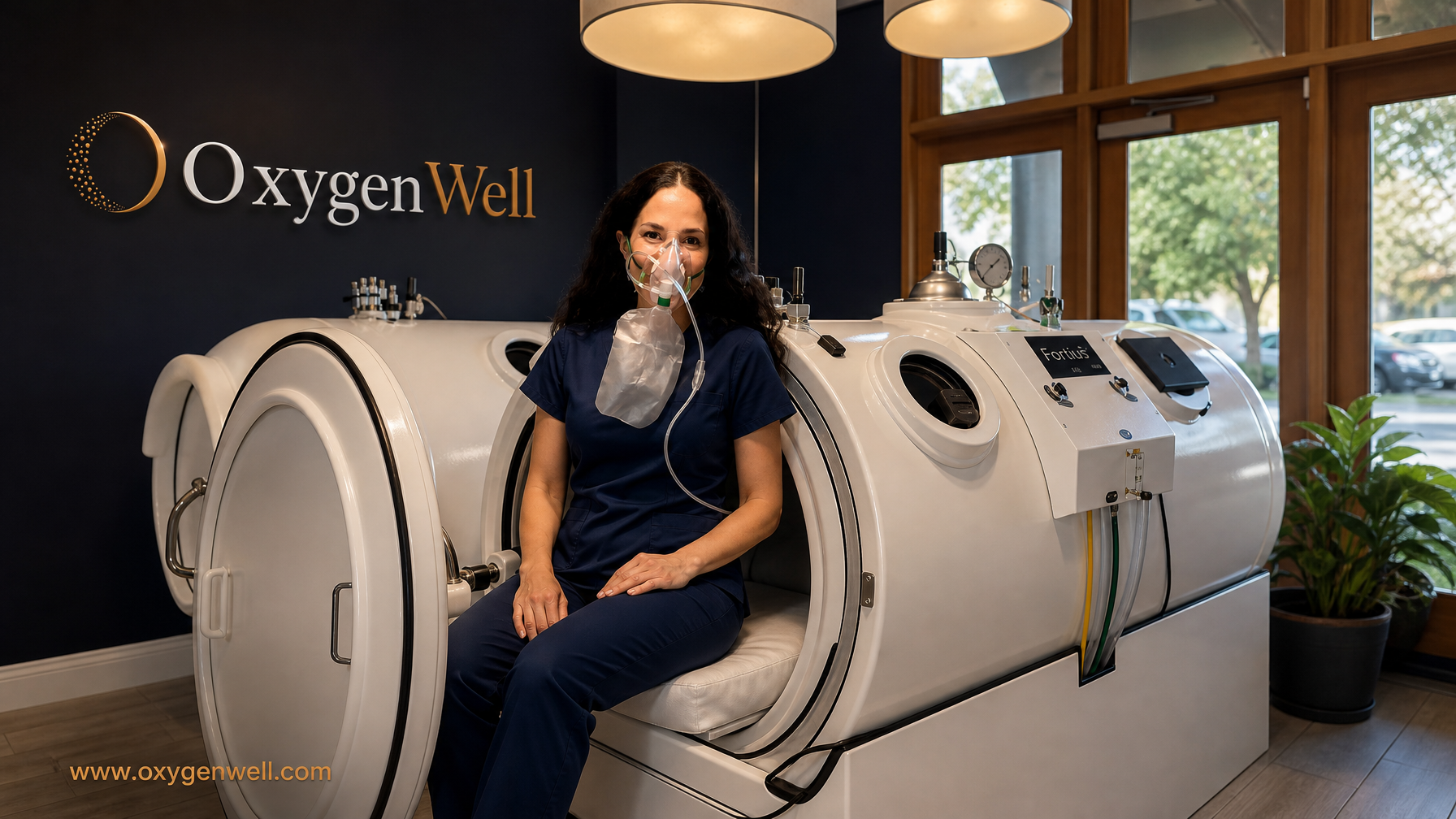
Inside an OxygenWell Fortius 420 chamber, you breathe 100% medical-grade oxygen at pressures up to 2.4 ATA. This combination of pressure and concentration forces oxygen to dissolve directly into your plasma — bypassing red blood cells entirely and reaching tissue that has been cut off from normal circulation.
Here is what that means for breast surgery recovery:
Immediate Phase (Sessions 1–5)
- Tissue oxygen levels rise 10–15x above baseline
- Inflammatory mediators (TNF-α, IL-6) begin to normalize
- ATP production restores in oxygen-starved surgical tissue
- Edema reduction begins as HBOT vasoconstricts without causing ischemia
Early Healing Phase (Sessions 5–15)
- VEGF surges, triggering angiogenesis — new capillary growth into surgical tissue
- Fibroblast activity increases, accelerating collagen deposition
- CD34+ stem cell mobilization begins (up to 8x baseline by session 10)
- Bruising resolves faster as damaged capillaries are repaired
Consolidation Phase (Sessions 15–20+)
- Mature new blood vessel networks are established in operated tissue
- Scar formation is modulated — collagen lays down more evenly
- Oxidative stress markers (CRP, 8-OHdG) continue to decline
- For reconstruction patients, tissue viability is secured and implant integration improves
HBOT for Breast Augmentation Recovery
Breast augmentation is the single most commonly performed cosmetic surgery in the United States. Despite its routine nature, the procedure creates substantial tissue trauma: the pectoralis major muscle is elevated (in submuscular placements), breast tissue is displaced, and a foreign body — the implant — is introduced into a pocket that the body must learn to tolerate.
The standard recovery involves 1–2 weeks of restricted activity, significant soreness, and visible swelling and bruising that can take 4–8 weeks to fully resolve. For patients with demanding careers or social calendars, this timeline matters.
HBOT compresses that timeline. Most augmentation patients notice a marked reduction in swelling and bruising within the first 3–5 sessions. By sessions 8–10, many patients report feeling closer to their final result, with softer, more settled tissue than they would expect at the same point without treatment.
The biological reason: augmentation creates a zone of relative hypoxia around the implant pocket. In that oxygen-depleted environment, fibroblasts lay down disorganized collagen — a precursor to thicker, tighter scar tissue. HBOT restores oxygen to that pocket, which guides collagen toward organized, pliable deposition and reduces the probability of an abnormal healing response.
Who Benefits Most from HBOT After Augmentation?
- Patients who bruise easily or have slow wound healing history
- Patients with prior augmentation who are replacing implants (more vascular disruption)
- Smokers or former smokers (HBOT partially compensates for impaired oxygen delivery)
- Patients with a family history of capsular contracture
- Anyone with a timeline — returning to work, a vacation, or an event within 4–6 weeks of surgery
HBOT for Breast Reduction and Lift Recovery
Breast reduction (reduction mammaplasty) and mastopexy (breast lift) carry a distinct set of healing challenges that make HBOT particularly relevant. Both procedures require longer incisions, more extensive tissue rearrangement, and in reduction surgery, the repositioning of the nipple-areola complex on a vascular pedicle. That pedicle must maintain adequate blood flow to keep the nipple viable — and any disruption to that supply can result in partial nipple loss, one of the most feared complications in reduction surgery.
HBOT directly addresses this risk. By saturating plasma with dissolved oxygen and stimulating angiogenesis, HBOT supports marginal tissue perfusion in the critical days following surgery. Even when a pedicle is under mild tension or has borderline perfusion, the oxygen density created by HBOT can be the difference between a nipple that heals and one that does not.
Beyond nipple viability, breast reduction patients tend to have larger incision areas and more tissue disruption than augmentation patients. The T-anchor or lollipop incisions used in most reductions create multiple wound convergence zones — points where three tissue edges meet under tension, which are inherently prone to delayed healing. HBOT's collagen-stimulating and anti-inflammatory effects are well-suited to these high-risk wound points.
HBOT for Breast Reconstruction After Mastectomy
Breast reconstruction after mastectomy is where HBOT moves from recovery optimization into clinical necessity. The complications of breast reconstruction — mastectomy skin flap ischemia, implant exposure, wound dehiscence, nipple necrosis in nipple-sparing procedures — share a common root cause: inadequate oxygen delivery to surgically devascularized tissue.
Mastectomy creates thin skin flaps that survive on the most peripheral blood supply. When those flaps are compromised by tension, prior radiation, or surgical technique, they begin to show signs of ischemia: dusky color change, marginal necrosis, or outright skin loss. Without intervention, a threatened reconstruction can fail entirely — forcing implant removal and leaving a patient without reconstruction, having survived cancer only to lose the result they were promised.
HBOT is the only non-surgical intervention that directly restores oxygen to ischemic mastectomy flaps. Evidence consistently shows that early initiation — within 24 to 72 hours of identifying compromised tissue — offers the best chance of flap salvage.
A 2024 retrospective study published in the American Journal of Surgery (Daniel et al., Am J Surg. 2024;116110) assessed HBOT in 23 patients with mastectomy skin flap ischemia following immediate breast reconstruction. The majority of patients who received HBOT avoided major complications, including implant loss. The authors concluded that HBOT is advantageous in treating and preventing postoperative ischemic complications following breast surgery. Source: American Journal of Surgery, 2024
A PMC-published case series of 50 breasts treated with HBOT for mastectomy flap ischemia similarly demonstrated that early HBOT intervention reduced the need for surgical revision and preserved reconstruction outcomes in patients who would otherwise have faced flap loss. Source: PMC, 2021
HBOT After Radiation-Damaged Breast Reconstruction
The reconstruction challenge intensifies for patients who have received chest wall radiation prior to or following mastectomy. Radiation fibrosis reduces the vascularity of breast skin significantly over time. Attempting reconstruction on irradiated tissue — whether with expanders, implants, or autologous flaps — carries substantially higher complication rates than reconstruction in non-irradiated tissue.
HBOT is an FDA-approved treatment for delayed radiation injury, and its use in the setting of irradiated breast reconstruction has strong support in the literature. A 2024 systematic review published in the Journal of Clinical Medicine (MDPI) evaluated HBOT for complications in nipple-sparing mastectomy with breast reconstruction, finding consistent benefit in preventing and treating ischemic complications — particularly in post-irradiated patients. Source: MDPI Journal of Clinical Medicine, 2024
At OxygenWell, we see a meaningful number of breast reconstruction patients who have received radiation. In these cases, HBOT serves both as a pre-operative tissue preparation tool (improving the vascular environment before reconstruction begins) and as a post-operative protective measure. If you are planning breast reconstruction after radiation, starting HBOT before your procedure — in coordination with your plastic surgeon — may meaningfully improve your outcome.
Can HBOT Reduce the Risk of Capsular Contracture?
Capsular contracture — the abnormal hardening and tightening of scar tissue around a breast implant — is the most common long-term complication of breast augmentation and implant-based reconstruction. It affects an estimated 10–40% of augmentation patients over time, depending on implant placement, surface texture, and individual healing biology.
The root cause of capsular contracture is multifactorial, but chronic subclinical inflammation and biofilm formation on the implant surface are central drivers. Fibroblasts responding to that low-grade inflammation lay down excessive, disorganized collagen — the capsule tightens, and the result ranges from mild firmness to severe pain and implant distortion.
HBOT addresses several of the upstream causes of capsular contracture:
- Inflammation modulation: HBOT consistently reduces CRP, TNF-α, and IL-6 — the same inflammatory markers implicated in capsular contracture pathogenesis.
- Collagen organization: Oxygenated fibroblasts produce more organized, pliable collagen rather than the dense, cross-linked collagen of a mature contracture capsule.
- Antimicrobial effect: HBOT has direct bacteriostatic and bactericidal effects at tissue level, potentially reducing biofilm burden — a recognized contributor to capsular contracture.
- Oxidative stress reduction: Glutathione levels increase significantly with HBOT, reducing the oxidative environment that drives abnormal scarring.
Patients with a prior history of capsular contracture are among those we most actively recommend for early post-surgical HBOT.
What the Research Says
The peer-reviewed literature on HBOT and breast surgery recovery is growing, with the strongest evidence in the reconstruction setting:
- Daniel et al., Am J Surg (2024): Retrospective analysis of 23 patients with mastectomy skin flap ischemia treated with HBOT demonstrated significant benefit in preventing major complications including implant loss. Source
- Rajpal et al., Georgetown/MedStar (2022): Case series demonstrating that early HBOT initiation for post-mastectomy flap necrosis rescued otherwise non-viable tissue. Mastectomy skin flap necrosis was reported in 30–52% of breast reconstruction patients. Source
- Shuck et al., Gland Surgery: HBOT has a meaningful role in preventing nipple loss in high-risk nipple-sparing mastectomy reconstruction cases. Source
- Systematic Review, MDPI J Clin Med (2024): Consistent benefit found for HBOT in nipple-sparing mastectomy reconstruction complications, particularly in post-irradiated patients. Source
- Durham et al., Plast Reconstr Surg (2017): Up to 2x higher flap survival rates with HBOT for compromised skin grafts and flaps — directly applicable to reconstructive breast surgery.
How Many Sessions Do You Need?
At OxygenWell, every breast surgery recovery protocol is personalized to the patient's specific procedure, surgical history, and healing goals. General frameworks by procedure type:
Breast Augmentation (Cosmetic)
- Preventive / Optimization: 5–10 sessions, starting within 24–48 hours of surgery. Daily or every other day, 1.5–2.0 ATA, 60–90 minutes.
- Standard Recovery: 10–15 sessions. Addresses persistent swelling, discomfort, and supports implant pocket stabilization.
Breast Reduction / Mastopexy
- 10–15 sessions, with emphasis on the first week post-operatively. 1.5–2.0 ATA, 90 minutes.
Implant-Based Breast Reconstruction
- Uncomplicated reconstruction: 10–20 sessions. 1.5–2.0 ATA, 90 minutes daily.
- Compromised or ischemic flap: 20–40 sessions. Daily, 2.0–2.4 ATA, 90 minutes. Initiated urgently when flap compromise is identified.
- Post-irradiated tissue: 20–40 sessions. Pre-operative tissue preparation recommended 4–6 weeks before reconstruction; post-operative protection follows.
Free Flap Reconstruction (TRAM, DIEP, Latissimus Dorsi)
- 10–20 sessions post-operatively. May be initiated within 24–48 hours if early ischemia is identified. 2.0–2.4 ATA, 90 minutes.
Does Insurance Cover HBOT After Breast Surgery?
For cosmetic breast augmentation and most breast reduction procedures, HBOT is considered off-label and is not covered by Medicare or PPO insurance as a stand-alone benefit.
Coverage may apply in the following scenarios:
- Compromised skin flap or skin graft following mastectomy: This is an FDA-approved, on-label HBOT indication. If your plastic surgeon documents compromised skin flap or graft failure in the post-mastectomy reconstruction setting, Medicare and most PPO plans will cover HBOT.
- Delayed radiation injury: If you developed radiation tissue damage prior to or as a complication of breast cancer treatment, HBOT for that radiation injury is FDA-approved and insurance-covered.
- Wound dehiscence or surgical wound failure: If a breast surgery wound fails to heal normally, your surgeon's documentation of impaired healing may qualify for insurance-covered HBOT.
OxygenWell works with a dedicated billing company that handles all insurance pre-authorizations. We will review your situation and help determine whether coverage applies before you begin treatment.
Why OxygenWell for Breast Surgery Recovery in Los Angeles
Not every hyperbaric center is the same. For breast surgery patients — particularly reconstruction patients with radiation history or compromised tissue — the quality of the facility, equipment, and clinical oversight matters enormously.
- True 2.4 ATA rated chambers: Our Fortius 420 monoplace chambers are fully rated to 2.4 ATA — not adjusted to 2.0 ATA as many centers operate.
- Medical-grade oxygen delivery: We use a high-flow medical oxygen system, not a standard 10-liter concentrator. The purity and concentration of oxygen you breathe makes a direct difference in tissue oxygen levels achieved.
- Grounded chambers: Our chambers are grounded — a critical fire safety standard that not every HBOT center meets.
- Integrative functional medicine perspective: Dr. Beth Meneley brings 25+ years in integrative medicine to every patient encounter. For breast surgery recovery, this means your protocol considers your whole health picture — inflammatory status, nutritional support, supplement protocols, and the interplay between HBOT and your overall healing biology.
- Experienced care team: Our Certified Hyperbaric Technicians (CHTs) — most of whom are EMT-certified — supervise every session. A Physician Assistant is on-site during most weekday hours.
- Extended hours: We offer evening and weekend sessions — rare among HBOT centers in Los Angeles. Post-surgical patients can schedule around work and recovery needs.
- Two convenient locations: Sherman Oaks and Calabasas, serving patients from across Los Angeles, the San Fernando Valley, Conejo Valley, and beyond.
Frequently Asked Questions
When should I start HBOT after breast augmentation?
Ideally within 24–48 hours of surgery, once your surgeon clears you for outpatient activity. Starting early captures the most benefit during the acute inflammatory phase when HBOT's anti-edema and oxygen-delivery effects are most impactful.
Is HBOT safe with breast implants?
Yes. Both saline and silicone breast implants are safe under hyperbaric pressure conditions at the ATA levels used therapeutically (1.5–2.4 ATA). The implant shell does not compress or deform under these pressures, and HBOT centers have treated breast implant patients for decades without implant-related adverse events.
Can HBOT help if I am weeks or months post-surgery with persistent swelling or poor scarring?
Yes. While the acute anti-edema effects are strongest in the first weeks, HBOT's angiogenesis-stimulating and collagen-modulating effects remain active for months following surgery. Patients with persistent hardness, scarring, or wound concerns at 4–12 weeks post-surgery can still see meaningful improvement.
How does HBOT interact with pain medications after surgery?
HBOT has no known adverse interactions with standard post-surgical pain management regimens. HBOT itself has an analgesic effect — many patients report reduced reliance on pain medication after beginning treatment. Your specific medication list is reviewed as part of your HBOT medical intake.
Do I need a referral from my plastic surgeon?
A referral is not required to schedule a consultation at OxygenWell. However, we strongly encourage coordination with your plastic surgeon — particularly for reconstruction patients. We are accustomed to working alongside plastic surgeons and welcome direct provider communication to align your protocol with your surgical recovery plan.
Does HBOT hurt?
HBOT sessions are generally well-tolerated. The most common sensation is mild ear pressure during pressurization, similar to what you feel when a plane descends. Our technicians guide you through a simple equalization technique that resolves this in seconds. Most patients find sessions relaxing — many read, watch a movie, or simply rest during their 60–90 minute treatment.
Ready to Heal Faster After Breast Surgery?
Whether you are planning a breast augmentation in Los Angeles, recovering from a reduction, or navigating the complex terrain of post-mastectomy reconstruction, OxygenWell is here to support your healing at the cellular level.
Call us at (818) 661-0939 or visit www.oxygenwell.com to schedule your consultation. Our Sherman Oaks and Calabasas locations serve patients across Los Angeles, the San Fernando Valley, Conejo Valley, and beyond.
Article reviewed by Dr. Beth Meneley, DAOM, L.Ac. — 25+ years in integrative medicine, 12+ years dedicated to hyperbaric medicine in Los Angeles, 50,000+ supervised HBOT sessions.
