


Table of Contents
- TLDR
- What Is Necrotizing Fasciitis?
- Types of Necrotizing Soft Tissue Infections
- Why Standard Treatment Alone Often Falls Short
- How Hyperbaric Oxygen Therapy Works for Necrotizing Fasciitis
- What the Research Shows: Mortality, Amputations, and Debridements
- The HBOT Protocol for Necrotizing Soft Tissue Infections
- Is HBOT for Necrotizing Fasciitis Covered by Insurance?
- Who Qualifies for HBOT After Necrotizing Fasciitis?
- Why OxygenWell for Necrotizing Fasciitis Recovery
- Frequently Asked Questions
TLDR
- Necrotizing fasciitis ("flesh-eating disease") is a rapidly spreading bacterial infection that destroys muscle fascia and subcutaneous tissue — with mortality rates of 20–80% even with aggressive surgery and antibiotics. (StatPearls, 2023)
- Hyperbaric oxygen therapy (HBOT) is an FDA-approved, insurance-covered adjunct treatment for necrotizing soft tissue infections (NSTIs).
- A large multicenter study found that for the most critically ill patients, HBOT reduced deaths from 23% to 4% — and patients who did not receive HBOT were 10.6 times less likely to survive their hospitalization. (Shupak et al., Ann Surg 2014)
- A 2023 systematic review confirmed that HBOT significantly reduces mortality rates and the number of surgical debridements required for NSTIs. (Faunø Thrane et al., World J Emerg Surg 2023)
- OxygenWell provides HBOT for NSTI patients in Los Angeles, with Medicare, PPO, and major insurance accepted for this FDA-approved indication.
What Is Necrotizing Fasciitis?
Necrotizing fasciitis (NF) is one of the most rapidly destructive bacterial infections a person can experience. Unlike ordinary infections that spread slowly, necrotizing fasciitis travels along the fascial plane — the thin layer of connective tissue beneath the skin — at a rate that can advance centimeters per hour. The overlying skin appears deceptively normal in the early stages. By the time the external signs become unmistakable, the damage underneath is already catastrophic.
The infection proceeds through a predictable sequence. In the first 24–48 hours, patients typically experience pain that seems wildly out of proportion to whatever visible injury or wound may be present. Within three to five days, the overlying skin transitions from an angry red to a blue-gray hue, blisters form, and the skin begins to die. In advanced stages, the destruction extends through the fascia into underlying muscle, with patients developing fever, low blood pressure, and septic shock. (StatPearls — Necrotizing Fasciitis, 2023)
Necrotizing fasciitis affects approximately 0.4 per 100,000 people annually in the United States, with mortality rates reported between 20% and 80% depending on the speed of diagnosis and the patient's underlying health status. (StatPearls, 2023)
The bacteria responsible for most cases are either Group A Streptococcus (the so-called "flesh-eating bacteria") acting alone, or a combination of gram-negative and anaerobic organisms working together. Patients with diabetes, liver disease, obesity, or a compromised immune system face substantially elevated risk.
Types of Necrotizing Soft Tissue Infections
Type 1: Polymicrobial Infection
The most common form. Multiple bacterial species — both aerobic and anaerobic organisms — work synergistically to cause progressive tissue death. Type 1 infections most commonly affect the trunk, perineum, and abdominal wall, and are frequently seen in patients with diabetes or peripheral vascular disease.
Type 2: Monomicrobial Infection (Group A Strep)
A single organism, most often Group A Streptococcus or Staphylococcus aureus, causes this form. Type 2 infections are more likely to affect the extremities and can occur in otherwise healthy individuals — sometimes following a minor cut, insect bite, or even a surgical incision.
Fournier's Gangrene
Fournier's gangrene is a type of necrotizing fasciitis involving the genitals, perineum, and perianal region. First described in 1883, it remains a surgical emergency today. It predominantly affects men, and risk factors include diabetes, obesity, and immunosuppression. Despite its dramatic presentation, Fournier's gangrene is treated with the same core approach as other NSTIs: emergency surgery, broad-spectrum antibiotics, and adjunctive hyperbaric oxygen therapy.
Gas Gangrene (Clostridial Myonecrosis)
Gas gangrene is a clostridial infection that produces gas in the tissues and causes rapid, progressive muscle necrosis. It has been treated with HBOT since the 1960s and is included among the FDA-approved indications for hyperbaric oxygen therapy.
Why Standard Treatment Alone Often Falls Short
The standard treatment for necrotizing fasciitis is aggressive surgical debridement — the removal of all dead and infected tissue — combined with broad-spectrum intravenous antibiotics. In severe cases, patients require multiple surgeries, sometimes daily, to stay ahead of the spreading infection.
Even with this approach, outcomes are often grim. A Cochrane review noted that mortality from necrotizing fasciitis remains in the range of 30–40% even with early aggressive surgical intervention and appropriate antibiotic therapy. (Cochrane Database Syst Rev 2015)
Hypoxic tissue creates a bacterial sanctuary. The bacteria driving NF — particularly anaerobic organisms — thrive in low-oxygen environments. As the infection progresses, it causes thrombosis of the small blood vessels in the fascia. This cuts off oxygen delivery from the bloodstream, creating a hospitable environment for bacterial growth while limiting the immune system's ability to fight back. Antibiotics also require oxygen-rich tissue to reach effective concentrations; in the hypoxic zone, their penetration drops sharply.
Each surgery is another assault on already-compromised tissue. Multiple debridements are often necessary because the initial surgery cannot fully define the infected margins in real time. Anything that helps stop the spread earlier reduces the need for additional debridements — and has direct value for the patient.
How Hyperbaric Oxygen Therapy Works for Necrotizing Fasciitis
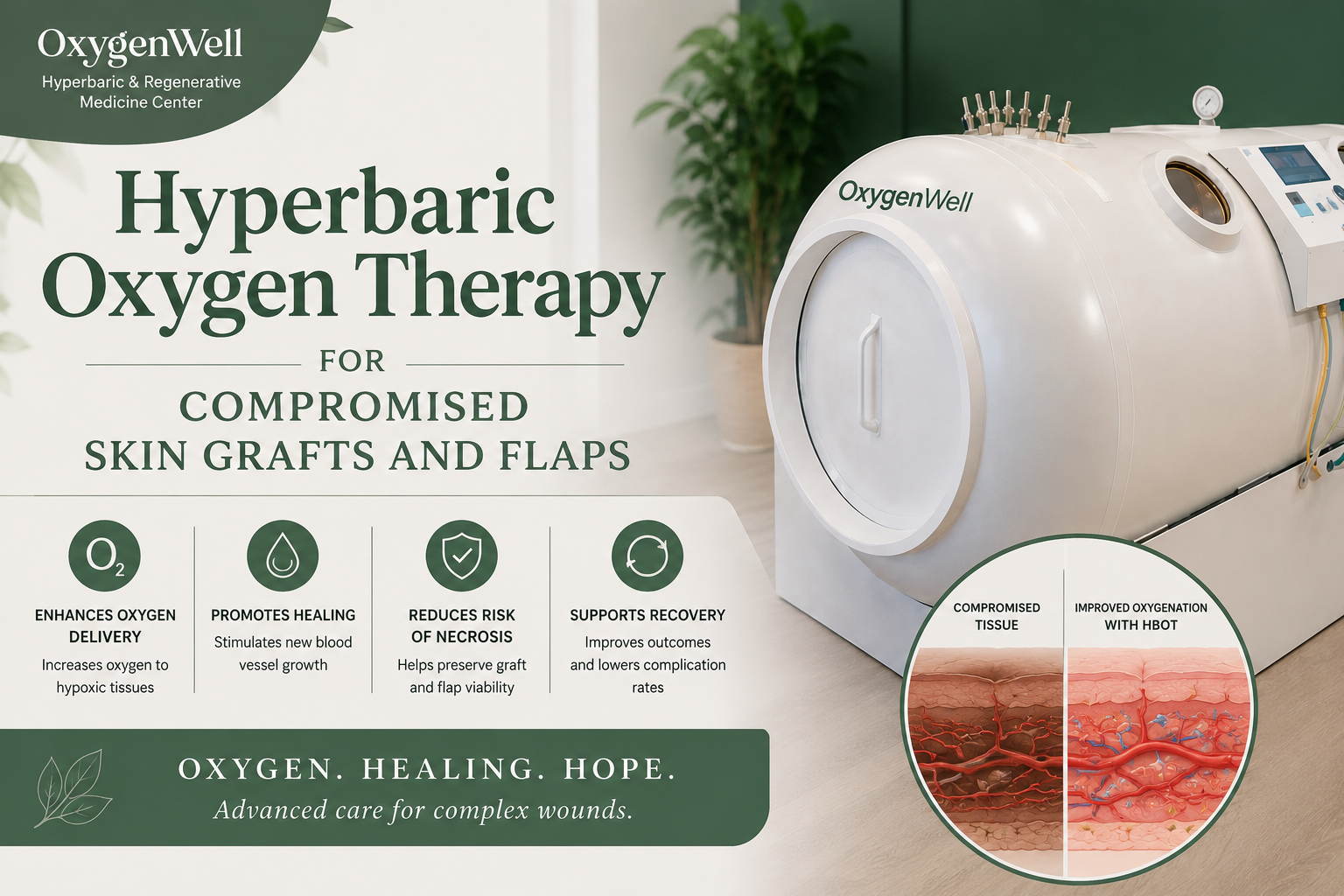
Hyperbaric oxygen therapy involves breathing 100% medical-grade oxygen inside a pressurized chamber, typically at 2.0 to 3.0 ATA (atmospheres absolute). At this pressure, the amount of oxygen dissolved in the blood plasma increases dramatically — far beyond what breathing room air or even standard supplemental oxygen can achieve.
Directly toxic to anaerobic bacteria. Many of the organisms driving NSTI — including clostridia and bacteroides — are obligate anaerobes that cannot survive in a high-oxygen environment. HBOT saturates previously hypoxic tissue with oxygen, making it lethal to these organisms. (Cochrane 2015)
Restores white cell killing power. Neutrophils require oxygen to power their bacterial-killing mechanism (the oxidative burst). In the hypoxic zones created by NF, neutrophil function is dramatically impaired. HBOT restores the oxygen gradient these cells need to function. (Cochrane 2015)
Enhances antibiotic penetration. Antibiotics such as aminoglycosides are substantially more effective in well-oxygenated tissue. By increasing tissue oxygen tension, HBOT makes the antibiotics a patient is already receiving more potent.
Reduces edema and inflammation. HBOT has a well-documented vasoconstrictive effect on healthy blood vessels without compromising oxygen delivery. This reduces the edema that accumulates in infected tissue, reducing pressure-related tissue injury and improving local perfusion.
Defines the surgical margin more clearly. By reducing the spread of infection and improving the viability of borderline tissue, HBOT helps surgeons identify viable tissue boundaries more accurately on subsequent debridements — reducing unnecessary tissue removal.
What the Research Shows: Mortality, Amputations, and Debridements
The survival data
A rigorous multicenter study queried the University Health Consortium database, examining over 1,500 NSTI cases at 14 centers that maintained their own HBOT facilities. The study matched patients by validated severity of illness scores to control for patient acuity.
For the most critically ill patients (extreme severity of illness):
- Fewer deaths in the HBOT group: 4% vs. 23% (p<0.01)
- Fewer complications in the HBOT group: 45% vs. 66% (p<0.01)
- Patients who did not receive HBOT were 10.6 times less likely to survive their hospitalization (OR 10.6; 95% CI 5.2–25.1)
The authors concluded that HBOT is "both a cost-effective and life-saving therapy, in particular for the sickest patients." (Shupak et al., Ann Surg 2014)
The 2023 systematic review
A 2023 systematic review examining the effect of HBOT on clinical outcomes in NSTIs found that the current evidence supports the use of HBOT to significantly reduce mortality rates and the incidence of complications. (Faunø Thrane et al., World J Emerg Surg 2023)
Amputation and debridement
A 2006 study found that adjuvant HBOT reduced both mortality and the amputation rate in necrotizing fasciitis patients. (Korhonen et al., Ann Surg 2006) Reducing the number of debridements matters enormously for long-term quality of life — fewer surgeries mean less scarring, fewer complications, and a faster return to function.
The HBOT Protocol for Necrotizing Soft Tissue Infections
HBOT for NSTI is an adjunct — not a replacement — for surgery and antibiotics.
Acute phase (first 24–72 hours post-surgery): Treatment begins as soon as the patient is hemodynamically stable enough to transfer to the hyperbaric chamber. Multiple sessions per day may be administered in the most critical cases — typically two to three sessions daily at 2.0–3.0 ATA, each lasting 90 minutes.
Subacute phase: Once the acute infectious process is controlled, treatment frequency typically shifts to once daily at 2.0–2.4 ATA. The total number of sessions depends on the severity of the infection and the rate of clinical improvement.
At OxygenWell, we coordinate directly with the surgical and infectious disease teams managing NSTI patients to ensure seamless integration of HBOT into the overall treatment plan.
Is HBOT for Necrotizing Fasciitis Covered by Insurance?
Yes. Necrotizing soft tissue infections are one of the FDA-approved indications for hyperbaric oxygen therapy, and Medicare and most PPO insurance plans cover HBOT for this condition when it is performed at a qualified facility.
OxygenWell is an insurance-approved hyperbaric facility. Our billing team handles all pre-authorizations and works directly with your insurer to maximize your coverage. Call our team at (818) 661-0939 to verify your benefits before treatment begins.
Who Qualifies for HBOT After Necrotizing Fasciitis?
- Patients who have undergone surgical debridement for necrotizing fasciitis and are hemodynamically stable enough for HBOT
- Patients with Fournier's gangrene in the post-debridement phase
- Patients with gas gangrene (clostridial myonecrosis)
- Patients who have had multiple debridements with persistent wound issues or marginal tissue viability
- Patients with diabetes, peripheral vascular disease, or other conditions that impair healing and increase the risk of treatment failure
HBOT is initiated in coordination with the patient's surgical team. A thorough medical history review is conducted before any patient begins treatment.
Why OxygenWell for Necrotizing Fasciitis Recovery
Full-rated 2.4 ATA chambers. Most HBOT centers operate at 1.3–1.5 ATA — adequate for wellness applications but not for serious infections. OxygenWell's chambers are FDA-cleared and rated to 2.4 ATA, delivering the therapeutic pressure ranges required for NSTIs.
Medical-grade oxygen delivery. We use a high-flow medical-grade oxygen system, not a standard 10-liter oxygen concentrator. For a condition where bactericidal oxygen tension is the clinical goal, the quality and flow rate of oxygen matters.
Grounded chambers and rigorous safety protocols. All chambers at OxygenWell are grounded per NFPA 99 safety standards. Our Safety Director brings 12+ years of hyperbaric experience.
Insurance-approved facility. OxygenWell meets the medical oversight and safety standards required for Medicare and PPO insurance coverage — including for FDA-approved indications like NSTIs.
Experienced clinical leadership. Our team includes Certified Hyperbaric Technicians (most EMT-certified), with a Physician Assistant on-site most weekday hours. Every patient receives a personalized protocol.
Extended hours. OxygenWell offers evening and weekend availability — rare among HBOT centers and critical when a patient needs to maintain a twice-daily treatment schedule following hospital discharge.
We serve patients throughout Los Angeles from our Sherman Oaks and Calabasas locations.
Frequently Asked Questions
Can HBOT be started while a patient is still in the hospital for necrotizing fasciitis?
In most cases, HBOT is initiated during the acute hospitalization phase, once the patient is stable enough for transport. Post-discharge, patients can continue treatment at OxygenWell.
How many HBOT sessions are typically needed for necrotizing fasciitis?
The number of sessions varies based on disease severity and patient response. Acute-phase treatment may involve two to three sessions daily. Total treatment courses typically range from 10 to 30 or more sessions.
Is HBOT painful?
No. Patients lie inside the chamber and breathe normally while pressure gradually increases. Some patients experience mild ear pressure during pressurization — similar to the sensation of descending in an airplane — which resolves quickly. Sessions last approximately 90 minutes.
Does HBOT work for all types of necrotizing fasciitis?
HBOT is beneficial for both Type 1 (polymicrobial) and Type 2 (monomicrobial, including Group A Strep) NF, as well as Fournier's gangrene and gas gangrene. Its benefit is greatest when initiated early in the treatment course.
Can a physician refer a patient directly to OxygenWell for HBOT following NSTI surgery?
Yes. We work closely with surgeons, infectious disease specialists, and hospital teams throughout the Los Angeles area. Physicians can contact us directly at (818) 661-0939 to coordinate a referral.
A Note From Dr. Beth Meneley
In integrative medicine, I have spent more than 25 years watching patients navigate some of the most difficult health challenges imaginable. Necrotizing fasciitis is among the most frightening — because it moves so fast, and because even after surviving the initial hospitalization, patients face a long road of reconstruction, rehabilitation, and recovery.
What hyperbaric oxygen therapy offers in this context is a scientifically supported, FDA-approved tool that gives tissue a better chance to survive, gives the immune system the oxygen it needs to fight, and gives patients a better chance to keep their limbs and their lives. At OxygenWell, that is what we are here to provide.
If you or someone you care for is navigating recovery from a necrotizing soft tissue infection, I encourage you to reach out to our team. Our insurance specialists can verify coverage quickly, and our clinical team will coordinate directly with your surgical and hospital providers.
Call us at (818) 661-0939 or visit www.oxygenwell.com to learn more.
Dr. Beth Meneley, DAOM, L.Ac., is the Wellness Director and Co-Owner of OxygenWell Hyperbaric & Regenerative Medicine Center in Sherman Oaks and Calabasas, CA. She has 25+ years in integrative medicine, 12+ years dedicated to hyperbaric medicine, and has overseen 50,000+ supervised HBOT sessions.
This article is for informational purposes only and does not constitute medical advice. If you suspect necrotizing fasciitis or any other serious soft tissue infection, call 911 or go to your nearest emergency room immediately.
