


Table of Contents
- Why Tummy Tuck Recovery Is More Demanding Than Most Surgeries
- What HBOT Does to Your Healing Tissues
- 5 Key Benefits of HBOT After a Tummy Tuck
- Complications HBOT Can Help Prevent — and Treat
- When to Start HBOT After Abdominoplasty
- How Many Sessions Do You Need?
- Does Insurance Cover HBOT for Tummy Tuck Recovery?
- Why Patients Choose OxygenWell for Surgical Recovery in Los Angeles
- Frequently Asked Questions
A tummy tuck — medically known as abdominoplasty — is one of the most transformative body contouring procedures in plastic surgery. It removes excess skin and fat from the abdomen, tightens the underlying muscle wall, and can restore a flatter, firmer silhouette after pregnancy, significant weight loss, or years of stubborn abdominal laxity. The results can be life-changing. The recovery, however, is one of the most physically demanding of any cosmetic surgery.
At OxygenWell, we work closely with plastic surgery patients throughout Los Angeles — from Sherman Oaks to Calabasas — who want to do everything possible to heal faster, reduce complications, and protect the investment they have made in their results. For abdominoplasty patients, hyperbaric oxygen therapy (HBOT) has become one of the most powerful tools in that recovery process.
This article explains exactly how HBOT works, what the clinical evidence shows, and who is most likely to benefit.
Why Tummy Tuck Recovery Is More Demanding Than Most Surgeries
To understand why HBOT is so effective for tummy tuck recovery, it helps to understand what the surgery actually does to your body's tissue.
During a full abdominoplasty, the surgeon elevates a large skin and fat flap from the pubic area up to the ribs — a broad expanse of tissue that is temporarily separated from its underlying blood supply. The abdominal muscles are then sutured together in the midline, the excess skin is removed, and the remaining tissue is pulled down and closed under tension. The navel is repositioned through a new opening in the flap.
The result is a tighter, smoother abdomen — but the healing process involves:
- A large incision line under significant tension
- A skin flap with a temporarily compromised blood supply
- Disrupted lymphatic channels, which cause prolonged swelling
- Muscle plication (tightening), which restricts movement and creates deep tissue tension
- Dead space under the flap, where fluid can accumulate (seroma)
According to published literature, complications after abdominoplasty include seroma in 5 to 30% of patients, wound dehiscence (incision separation), infection, hematoma, and in the most serious cases, partial or full-thickness skin necrosis — particularly at the T-junction where vertical and horizontal incisions meet, or near the umbilicus, where blood supply is most tenuous.
All of these complications share a common root cause: inadequate oxygen delivery to healing tissue.
What HBOT Does to Your Healing Tissues
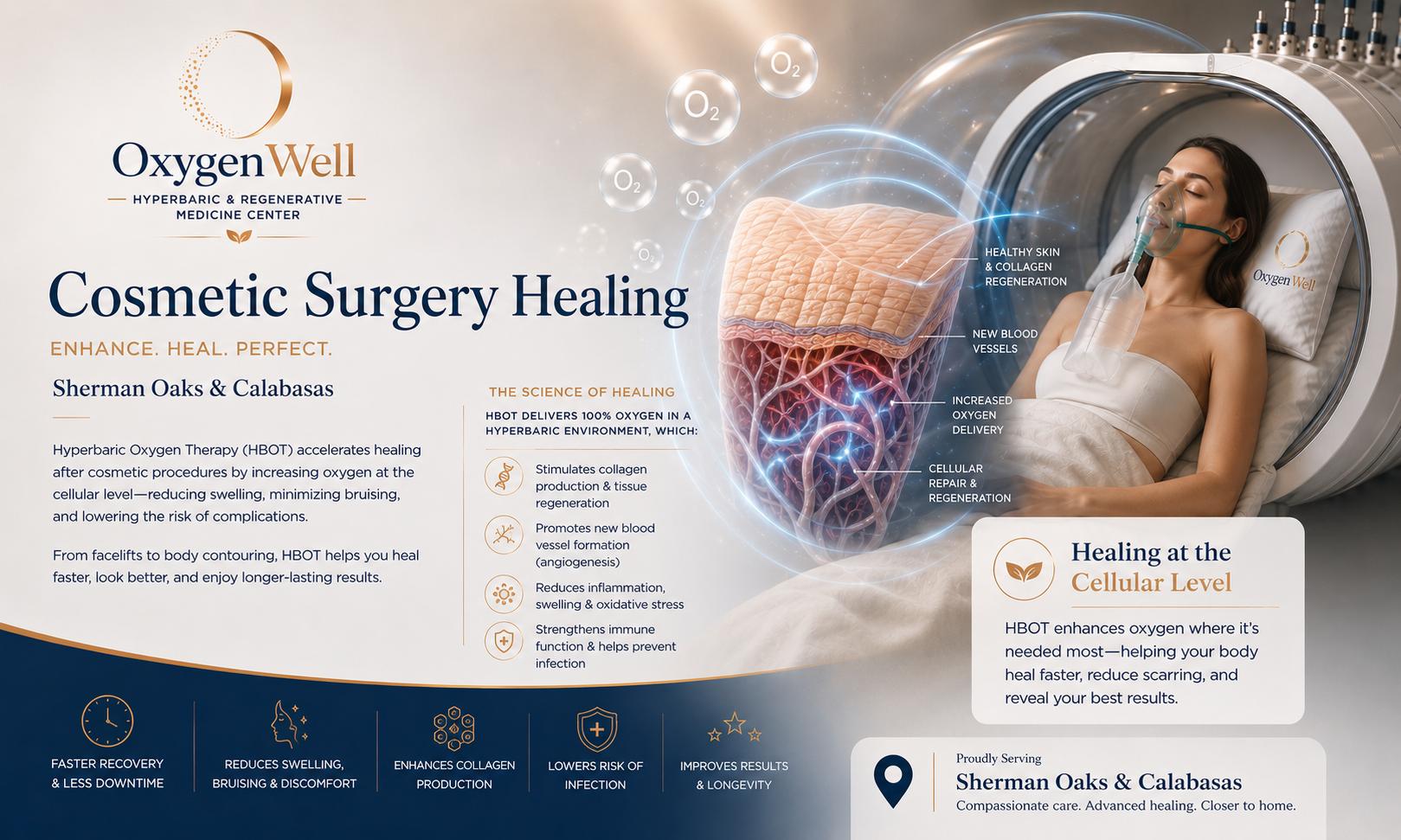
Hyperbaric oxygen therapy places you inside a pressurized chamber — rated to 2.4 ATA at OxygenWell — where you breathe 100% medical-grade oxygen. Under these conditions, oxygen dissolves directly into your blood plasma (not just your red blood cells), raising tissue oxygen levels 10 to 15 times above baseline. That surge of oxygen reaches areas where blood circulation has been disrupted — exactly the conditions that exist after a tummy tuck.
The physiological effects relevant to surgical recovery are well-documented:
- Angiogenesis: HBOT stimulates vascular endothelial growth factor (VEGF), triggering the formation of new capillaries that permanently improve blood flow to recovering tissue.
- Anti-inflammatory signaling: Pressurized oxygen suppresses pro-inflammatory cytokines (TNF-alpha, IL-6, NF-kB), reducing swelling and bruising.
- Collagen synthesis: Oxygen is the rate-limiting substrate for collagen production. Higher tissue oxygen means stronger, better-organized scar tissue.
- Antimicrobial effect: Elevated oxygen concentrations are directly bacteriostatic against anaerobic pathogens and enhance the oxidative killing capacity of white blood cells.
- Lymphatic restoration: Improved oxygenation supports lymphatic endothelial function, which helps clear the fluid accumulation responsible for post-surgical swelling.
- Stem cell mobilization: After 20 or more sessions, HBOT increases circulating CD34+ progenitor cells up to 8 times baseline — cells that migrate to injured tissue and support regeneration.
A 2024 study published in Plastic and Reconstructive Surgery Global Open reported on HBOT use across a range of aesthetic plastic surgery procedures, including abdominoplasty, and found that patients who received postoperative HBOT showed reduced complication rates, faster wound healing, and improved overall outcomes compared to standard care alone. (Ramirez et al., Plast Reconstr Surg Glob Open, 2024)
5 Key Benefits of HBOT After a Tummy Tuck
1. Dramatically Reduced Swelling and Bruising
Post-operative edema is one of the most uncomfortable and prolonged aspects of tummy tuck recovery. The abdominal flap disrupts lymphatic drainage pathways, and significant swelling can persist for weeks to months. HBOT's anti-inflammatory action begins immediately — most patients report visible reductions in swelling after just three to five sessions. Less swelling means less pain, better mobility, and a faster return to seeing your final results.
2. Faster Incision Healing
Oxygen is essential for every step of wound repair: inflammation, proliferation, and remodeling. The long horizontal incision of a tummy tuck — and the repositioned navel — heals faster when tissue oxygen is consistently elevated. Collagen cross-linking is more robust, incision edges close more firmly, and the risk of wound separation decreases substantially.
3. Protection Against Skin Flap Ischemia and Necrosis
The most feared complication of abdominoplasty is flap necrosis — tissue death caused by insufficient blood supply reaching the elevated skin. The areas most at risk are the T-junction and the tissue distal to the blood supply perforators. HBOT directly addresses this by hyperoxygenating the plasma, reaching tissue that red blood cells cannot access due to compromised microcirculation. Published case series document HBOT's ability to rescue at-risk flap tissue and prevent progression to full-thickness necrosis when started early. (Simman et al., Eplasty, 2022)
4. Reduced Risk of Infection
Surgical site infection is a significant risk with any procedure involving a large incision and dead space. Elevated tissue oxygen levels are directly antimicrobial — anaerobic bacteria cannot survive in a hyperoxygenated environment, and neutrophils (the immune system's first responders) require oxygen to perform their oxidative killing function. HBOT gives the immune system the fuel it needs to prevent infection before it takes hold.
5. Better Scar Outcomes
The quality of your scar depends heavily on collagen production during the remodeling phase of healing — a process that continues for six months to two years after surgery. Patients who begin HBOT in the early weeks after a tummy tuck set the stage for better-organized collagen deposition, which translates to a flatter, softer scar over time. For many tummy tuck patients, scar quality is a major concern, and HBOT offers a clinically meaningful advantage here.
Complications HBOT Can Help Prevent — and Treat
HBOT is valuable both as a preventive measure in uncomplicated recovery and as a therapeutic intervention when complications arise.
Wound Dehiscence
When a tummy tuck incision separates — even partially — it dramatically prolongs recovery and can require revision. HBOT accelerates closure of open wounds by saturating the wound bed with oxygen, stimulating granulation tissue, and promoting epithelialization. At OxygenWell, we have helped patients referred by their plastic surgeons for exactly this purpose: wounds that were not healing with standard care closed significantly faster with HBOT.
Compromised Skin Flap Survival
HBOT is an FDA-recognized treatment for compromised skin grafts and flaps — one of the 14 on-label, insurance-eligible indications for hyperbaric therapy. When a tummy tuck flap shows signs of vascular compromise (pallor, sluggish capillary refill, early eschar formation), HBOT can salvage tissue that would otherwise progress to necrosis. Research shows up to a 2x improvement in compromised flap survival rates with HBOT. (Durham WP et al., Plast Reconstr Surg, 2017)
Delayed Healing and Non-Healing Wounds
Some tummy tuck patients — particularly those who smoke, have diabetes, take corticosteroids, or have prior abdominal scars — carry higher risk for delayed healing. For these patients, HBOT is often the intervention that closes the wound when nothing else has worked. Published case data document complete closure of peri-umbilical abdominoplasty wounds after standard wound care had failed — achieved through a course of HBOT.
When to Start HBOT After Abdominoplasty
The earlier HBOT begins after surgery, the greater the benefit. Optimal timing is within the first 72 hours post-operatively, though meaningful benefit is still achievable throughout the first four to six weeks of recovery.
For most elective tummy tuck patients without complications, we recommend beginning HBOT within three to five days after surgery, once your plastic surgeon has cleared you for outpatient activity. Sessions are non-invasive, require no physical exertion, and are well-tolerated even in the early post-operative period — you simply recline inside the chamber and breathe normally.
If a complication has developed — wound separation, signs of flap compromise, or a non-healing area — contact us as soon as possible. HBOT should be initiated urgently in these situations, ideally within 24 hours of identifying the problem.
We always coordinate with your plastic surgeon. Our clinical team reviews your procedure details, your current healing status, and any relevant medical history before designing your protocol.
How Many Sessions Do You Need?
Protocol varies based on your surgical complexity, healing progress, and whether complications are present.
- Routine recovery support (no complications): 5 to 10 sessions, beginning within the first week post-op. Sessions run 60 to 90 minutes at 1.5 to 2.0 ATA. Most patients notice visible improvement in swelling and bruising within three sessions.
- High-risk patients (smokers, diabetics, those with prior abdominal surgeries, or elevated BMI): 10 to 15 sessions, starting as early as possible after surgery.
- Active wound complication or flap compromise: 20 to 40 sessions on a daily or near-daily schedule at 2.0 to 2.4 ATA, until the wound closes and tissue viability is confirmed.
At OxygenWell, we offer evening and weekend availability — a meaningful advantage for working patients managing a tummy tuck recovery. Daily sessions around your schedule are not only possible; they are how you get the most out of this therapy.
Does Insurance Cover HBOT for Tummy Tuck Recovery?
For routine elective tummy tuck recovery (uncomplicated healing), HBOT is generally not covered by Medicare or commercial insurance and is considered an out-of-pocket service.
However, if a complication has developed — specifically a compromised skin flap or a wound with ischemic features — HBOT may qualify as a covered FDA-approved indication (Compromised Skin Grafts and Flaps, or Wounds with Arterial Insufficiency). OxygenWell is an insurance-approved hyperbaric facility with a dedicated billing team that handles pre-authorization for all applicable conditions. If your wound qualifies, we will pursue coverage on your behalf.
Contact our team at (818) 661-0939 to discuss your specific situation, and we will advise whether an insurance pathway exists for your case.
Why Patients Choose OxygenWell for Surgical Recovery in Los Angeles
Most hyperbaric centers in Los Angeles operate at 1.3 to 1.5 ATA — the lower end of the therapeutic range. OxygenWell's chambers are FDA-cleared and rated to 2.4 ATA, delivering medical-grade oxygen at the pressures where the most significant angiogenic, anti-inflammatory, and wound-healing benefits occur. This is not a minor technical distinction. Dose matters in hyperbaric medicine, and pressure is the key variable.
As Wellness Director of OxygenWell and a Doctor of Acupuncture and Oriental Medicine with 25 years in integrative medicine, I approach every surgical recovery patient as a whole person — not just a wound site. We look at your full health picture: circulation, inflammation, nutritional status, and healing trajectory. Our protocols are personalized, not generic.
Additional differentiators that matter for surgical patients:
- Certified Hyperbaric Technicians (CHTs) on-site for every session, most of whom are EMT-certified
- PA on-site most weekday hours for clinical support
- Grounded monoplace chambers for maximum safety
- 100% medical-grade oxygen — not a standard 10-liter concentrator
- Evening and weekend hours to fit your recovery schedule
- Locations in Sherman Oaks and Calabasas, convenient for patients throughout the San Fernando Valley and greater Los Angeles
We work alongside your plastic surgeon, not independently of them. Communication with your surgical team is part of how we operate.
Frequently Asked Questions
Is HBOT safe right after a tummy tuck?
Yes, for most patients. HBOT is non-invasive and requires no physical exertion. You simply recline in the chamber and breathe. We typically recommend beginning within three to five days post-op with clearance from your plastic surgeon. There are no known interactions between HBOT and the standard medications used in tummy tuck recovery, including antibiotics and pain management agents.
Will HBOT interfere with my drains or compression garment?
No. Drains and compression garments are standard after abdominoplasty. We accommodate patients who still have surgical drains and work around your compression requirements. Let us know your current post-op status when you contact us.
Can HBOT treat a wound that has already opened?
Yes — this is one of HBOT's most established clinical applications. A wound that has separated or is not healing with standard wound care can often be closed with a targeted HBOT course. The sooner it begins after the complication is identified, the better the outcome. Do not wait weeks before seeking HBOT for a tummy tuck wound complication.
How soon will I see results?
Reduction in swelling and bruising is typically noticeable within three to five sessions. Incision healing improvements become visible within one to two weeks of consistent sessions. If you are treating an active wound complication, progress is reassessed after ten sessions and then weekly thereafter.
Do you work directly with plastic surgeons?
Yes. We actively accept physician referrals and coordinate with plastic surgery practices across the Los Angeles area. If you are a plastic surgeon interested in referring surgical recovery patients, please contact our team at (818) 661-0939.
Ready to Accelerate Your Recovery?
A tummy tuck is a significant investment — in time, in resources, and in the version of yourself you are working toward. HBOT gives your body the one thing it needs most to realize that investment: oxygen, delivered with precision, at the pressures that actually move the needle on healing.
OxygenWell serves patients throughout the Los Angeles area from our locations in Sherman Oaks and Calabasas. If you have recently had a tummy tuck or are planning one, we encourage you to contact us to discuss how HBOT can support your recovery.
Call us at (818) 661-0939 or visit www.oxygenwell.com to schedule a consultation.
Written by Dr. Beth Meneley, DAOM, L.Ac. — Wellness Director and Co-Founder, OxygenWell Hyperbaric and Regenerative Medicine Center. 25 years in integrative medicine. 12 years dedicated to hyperbaric medicine in Los Angeles. 50,000+ supervised HBOT sessions.
