TLDR
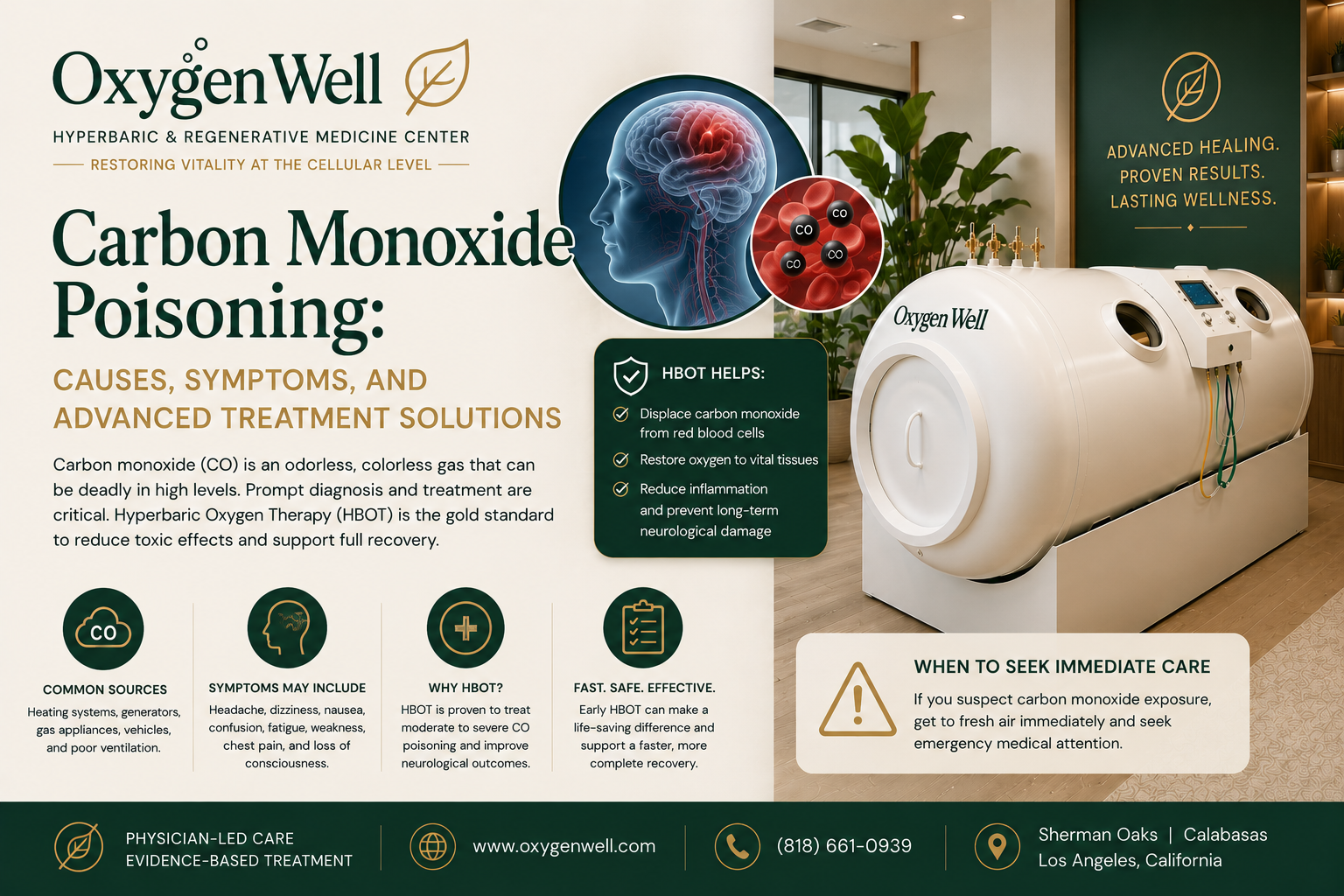
Carbon monoxide (CO) binds to hemoglobin 210 times more readily than oxygen, starving the brain and organs of oxygen. Hyperbaric oxygen therapy (HBOT) is an FDA-approved, emergency-level treatment that clears CO from the bloodstream dramatically faster than breathing room air or even standard normobaric oxygen — reducing carboxyhemoglobin (COHb) half-life from 5.5 hours to as little as 20 minutes. Delayed neurological sequelae (DNS) affect up to 40% of CO poisoning survivors and can appear weeks after apparent recovery. Early, physician-directed HBOT is the standard of care for severe CO poisoning in Los Angeles. OxygenWell offers hyperbaric oxygen treatment for CO poisoning at (818) 661-0939.
What Is Carbon Monoxide Poisoning?
Carbon monoxide is a colorless, odorless, tasteless gas produced by the incomplete combustion of carbon-based fuels — gasoline, natural gas, propane, wood, oil, and coal. Because CO has no detectable sensory properties, victims frequently lose consciousness before they recognize they are in danger.
In the United States, CO poisoning sends more than 50,000 people to emergency rooms each year and kills approximately 400 to 500 annually from non-fire sources alone, according to U.S. Consumer Product Safety Commission data. In California, the Los Angeles County Fire Department identifies faulty furnaces, portable generators, water heaters, and vehicles left running in enclosed garages as the most common sources.
Common causes of CO poisoning include:
- Malfunctioning or unvented gas appliances (furnaces, stoves, water heaters)
- Portable generators used indoors or in garages
- Vehicles running in enclosed spaces
- Wildfires and structure fires (critical for firefighters and first responders)
- Propane heaters used in tents or poorly ventilated spaces
- Charcoal grills used indoors
Symptoms of CO poisoning mirror flu-like illness without the fever: headache, nausea, dizziness, shortness of breath, confusion, and progressive loss of consciousness. At high concentrations (12,800 ppm), unconsciousness can occur within 2 to 3 breaths.
How CO Binds to Hemoglobin
To understand why HBOT works, you first need to understand the mechanism of CO toxicity.
Hemoglobin — the protein in red blood cells responsible for transporting oxygen — has a binding site that CO occupies with approximately 210 times greater affinity than oxygen (NCBI StatPearls, 2023). When CO binds to hemoglobin, it forms carboxyhemoglobin (COHb). This COHb molecule cannot carry oxygen. The result is functional anemia — hemoglobin is present in normal quantities, but it is chemically blocked from doing its job.
The damage does not stop there. CO also:
- Binds to myoglobin — the oxygen-storage protein in muscle cells, including cardiac muscle, impairing heart function.
- Inhibits cytochrome c oxidase — the enzyme at the core of mitochondrial energy production, effectively shutting down cellular respiration even in cells that do receive some oxygen.
- Triggers oxidative stress and lipid peroxidation — damaging cell membranes and initiating inflammatory cascades that injure the brain and nervous system at the molecular level.
This is why CO poisoning carries a different danger profile than simple suffocation. Even after CO is removed from hemoglobin, the cellular and neurological damage continues unless it is actively addressed.
Why Standard Oxygen Is Not Enough
The first step in any CO poisoning emergency is removing the patient from the CO source and delivering high-flow normobaric (normal atmospheric pressure) oxygen via a non-rebreather mask. This is standard emergency medical protocol and it is essential.
But for moderate to severe CO poisoning, normobaric oxygen has critical limitations.
Under normal atmospheric conditions, oxygen dissolves into blood plasma in very small quantities. The body relies primarily on hemoglobin to transport oxygen — but that is exactly the system CO has hijacked. While normobaric 100% oxygen reduces COHb half-life from approximately 5.5 hours (breathing room air) to roughly 60 to 90 minutes, it does not fully address:
- CO bound to intracellular proteins (myoglobin, cytochrome oxidase)
- Ongoing mitochondrial dysfunction
- Neurological inflammation triggered by the poisoning event
- The risk of delayed neurological sequelae developing days to weeks later
This is precisely where hyperbaric oxygen therapy becomes clinically irreplaceable.
How HBOT Eliminates CO from the Body
Hyperbaric oxygen therapy delivers 100% medical-grade oxygen at pressures of 2.4 to 3.0 ATA inside a pressurized chamber. Under these conditions, physics and physiology combine to resolve CO toxicity through several mechanisms:
1. Dramatic Acceleration of COHb Dissociation
Henry's Law states that gas dissolves into liquid in proportion to its partial pressure. At 2.4 to 3.0 ATA, the partial pressure of oxygen in the lungs is 17 to 21 times higher than at sea level. This physically forces CO off hemoglobin and out of the body through exhaled breath — reducing COHb half-life to as little as 20 to 23 minutes, according to Wound Care Education Partners (2024). Compared to breathing room air (5.5 hours), HBOT is approximately 16x faster at clearing CO from hemoglobin.
2. Oxygen Delivery Independent of Hemoglobin
At hyperbaric pressures, oxygen dissolves directly into blood plasma in quantities sufficient to sustain life even without functional hemoglobin. This plasma-dissolved oxygen can reach CO-bound tissues and cells that red blood cells cannot adequately supply, restoring aerobic metabolism in areas where the mitochondria had been shut down.
3. Restoration of Cytochrome Oxidase Function
HBOT directly displaces CO from cytochrome c oxidase — the final enzyme in the mitochondrial electron transport chain — restoring ATP production. This is a critical mechanism that normobaric oxygen cannot achieve at physiologically significant levels.
4. Reduction of Neurological Inflammation
CO poisoning triggers a delayed inflammatory response in the brain, including neutrophil adhesion to cerebral microvasculature, which contributes significantly to the neurological damage that appears days to weeks after poisoning. Research in NEJM (2002) and subsequent studies confirm that HBOT significantly reduces this inflammatory cascade and the cognitive sequelae it produces.
Neurological Sequelae: The Hidden Danger After CO Exposure
One of the most serious and underappreciated aspects of CO poisoning is Delayed Neurological Sequelae (DNS). DNS affects 10% to 40% of moderate-to-severe CO poisoning survivors and can appear days to weeks after the initial poisoning event — even in patients who appeared to make a full recovery.
DNS symptoms include:
- Memory impairment and cognitive decline
- Personality and behavioral changes
- Parkinsonism and movement disorders
- Depression and anxiety
- Headache and difficulty concentrating
- Dementia-like presentations in severe cases
MRI findings in DNS patients commonly show white matter changes consistent with hypoxic-ischemic injury and demyelination.
A landmark study published in Scientific Reports (2021), reviewing 7 years of patient data at a major medical center, found that patients who received HBOT for DNS showed significantly greater neuropsychiatric improvement at 12 months compared to those who did not receive HBOT. Earlier initiation of HBOT was associated with better outcomes — timing is critical.
A PubMed case report and literature review (2024) describes a patient who received a single HBOT session acutely and appeared to recover fully — then presented eight weeks later with progressive Parkinsonism. After 20 sessions of HBOT, neurological function was substantially restored. This case underscores that DNS can emerge even after initial improvement, and that HBOT retains therapeutic value well into the delayed phase.
Who Needs HBOT for CO Poisoning?
Not every CO exposure requires hyperbaric treatment. The physician-led team at OxygenWell evaluates each case individually. Clinical guidelines and UHMS recommendations support HBOT for CO poisoning when one or more of the following is present:
- Loss of consciousness at any point during or after exposure
- COHb level greater than 25% (or greater than 15 to 20% in pregnant patients)
- Neurological symptoms — confusion, altered mental status, syncope, seizures
- Cardiac involvement — ischemic changes on ECG, arrhythmia
- Extremes of age — young children and elderly patients at higher risk of complications
- Pregnancy — fetal hemoglobin binds CO more avidly than adult hemoglobin; the fetus is at elevated risk even with lower maternal COHb levels
- Development of DNS symptoms — even weeks after the initial poisoning
For patients who were exposed to CO but do not meet acute HBOT criteria, close neurological monitoring over 4 to 6 weeks remains essential. If DNS symptoms emerge, prompt HBOT evaluation should follow.
HBOT Treatment Protocol for CO Poisoning
At OxygenWell, CO poisoning treatment follows protocols aligned with the Undersea and Hyperbaric Medical Society (UHMS) and the clinical judgment of Dr. Beth Meneley and her medical team.
Acute CO Poisoning (initial treatment):
- Pressure: 2.4 to 3.0 ATA
- Session duration: 90 to 120 minutes
- Frequency: 1 to 3 sessions in the first 24 hours for severe cases
- Goal: Rapid COHb elimination, mitochondrial restoration, neurological inflammation reduction
Delayed Neurological Sequelae (DNS) Protocol:
- Pressure: 2.0 to 2.4 ATA
- Session duration: 90 minutes
- Total sessions: 20 to 40, depending on symptom severity and clinical response
- Frequency: Daily or 5 sessions per week
- Goal: White matter repair, restoration of cerebral perfusion, reduction of inflammatory burden
Every treatment course begins with a comprehensive medical evaluation. Because OxygenWell is physician-owned and carries full Medicare and PPO insurance approval, qualifying patients may have treatment costs covered — the billing team handles pre-authorization before sessions begin.
CO Poisoning and HBOT in Los Angeles
If you or a family member has experienced CO poisoning and are seeking HBOT treatment in the Los Angeles area, OxygenWell offers physician-directed hyperbaric oxygen therapy at two locations.
Why choose OxygenWell for CO poisoning treatment:
- FDA-approved HBOT at up to 2.4 ATA with 100% medical-grade oxygen
- Physician ownership under California law — not a wellness studio, a medical facility
- Grounded monoplace chambers with the highest safety standards in the region
- 12+ years of hyperbaric medicine expertise from Dr. Beth Meneley and 50,000+ supervised sessions
- Insurance approved — Medicare and PPO coverage for FDA-approved indications including CO poisoning
- Extended hours including evenings and weekends for follow-up DNS protocols
- Personalized treatment planning — no generic protocols, every patient evaluated by the physician team
OxygenWell's Sherman Oaks center is located at 15301 Ventura Blvd., Suite P-12, within the Sherman Oaks Galleria, with complimentary parking. The Calabasas location serves the western San Fernando Valley. Both clinics operate under the same standard of physician-led, medically rigorous care.
To schedule an evaluation or HBOT for CO poisoning, call (818) 661-0939 or visit oxygenwell.com/contact.
Frequently Asked Questions
Is HBOT the standard of care for carbon monoxide poisoning?
HBOT is the recommended treatment for moderate to severe CO poisoning according to the UHMS, Mayo Clinic, Johns Hopkins, and most major emergency medicine guidelines. It is FDA-approved for this indication and covered by Medicare and PPO insurance when medically indicated. For mild exposures, normobaric oxygen may be sufficient — a physician evaluation determines the appropriate level of care.
How quickly does HBOT work for CO poisoning?
HBOT clears CO from hemoglobin approximately 16 times faster than breathing room air. At 2.4 to 3.0 ATA, the carboxyhemoglobin half-life drops to as little as 20 minutes. Most patients show measurable improvement in neurological status within the first session. A full course of treatment for DNS may take 20 to 40 sessions over several weeks.
Can HBOT help if I already have neurological symptoms weeks after CO exposure?
Yes. Delayed neurological sequelae (DNS) from CO poisoning responds to HBOT even when symptoms appear days or weeks after the initial event. Research demonstrates meaningful neuropsychiatric improvement in DNS patients treated with HBOT compared to those who receive no hyperbaric treatment, with earlier initiation associated with better outcomes.
How is CO poisoning treated at the hospital versus at an HBOT clinic?
Hospitals provide emergency stabilization — removing the patient from CO exposure, establishing airway, and delivering high-flow normobaric oxygen. For patients requiring HBOT, hospitals ideally transfer to or coordinate with an accredited hyperbaric facility. OxygenWell works with referring physicians and emergency departments throughout the Los Angeles area to support CO poisoning patients who need follow-up HBOT for DNS or who were not treated with HBOT acutely.
Is HBOT safe for pregnant women with CO poisoning?
Pregnancy is one of the strongest indications for HBOT in CO poisoning. Fetal hemoglobin binds CO more avidly than adult hemoglobin, and fetal COHb levels persist longer than maternal levels. HBOT significantly reduces fetal exposure duration and the risk of fetal neurological injury. The physician team at OxygenWell evaluates each case on an individual basis.
What symptoms should prompt me to seek HBOT evaluation after possible CO exposure?
Seek immediate medical evaluation if you experience: persistent headache, memory problems, personality or behavior changes, difficulty with concentration, depression or anxiety, movement problems, or any neurological symptom — even if these appear days or weeks after the event. These may signal delayed neurological sequelae and warrant HBOT evaluation.
Where can I receive HBOT for CO poisoning in Los Angeles?
OxygenWell offers physician-led HBOT for CO poisoning in Sherman Oaks (15301 Ventura Blvd., Suite P-12) and Calabasas. Call (818) 661-0939 to speak with our clinical team.
This article is written for educational purposes and does not constitute medical advice. Carbon monoxide poisoning is a medical emergency. Call 911 immediately if you suspect CO poisoning. Contact OxygenWell at (818) 661-0939 to discuss HBOT evaluation for CO poisoning or delayed neurological sequelae.