


Primary keyword: hyperbaric oxygen therapy BBL recovery
Locations: Sherman Oaks & Calabasas, CA | Author: OxygenWell
TLDR
A Brazilian Butt Lift (BBL) transfers fat from one part of your body to your buttocks — and up to 40% of that fat can be reabsorbed in the first weeks after surgery. Hyperbaric Oxygen Therapy (HBOT) delivered at 2.4 ATA floods the graft with oxygen during the critical first 72 hours, supports new blood vessel growth, and reduces the inflammation and swelling that compromise fat survival. Most BBL patients at OxygenWell do 5–10 sessions starting within 24–72 hours of surgery. The result: better graft retention, faster visible recovery, and less bruising.
Table of Contents
- Why BBL Recovery Is Different from Other Surgeries
- What HBOT Does for Your BBL Recovery
- The Science: What Research Shows
- When to Start HBOT After a BBL
- How Many Sessions Do You Need
- What a Session Looks Like at OxygenWell
- Frequently Asked Questions
- Get Started in Sherman Oaks or Calabasas
Why BBL Recovery Is Different from Other Surgeries
A BBL involves two surgical sites: liposuction donor areas (typically the abdomen, flanks, or thighs) and the buttocks where the purified fat is injected. Both need to heal simultaneously. But the greater challenge is the fat graft itself.
Transferred fat cells are temporarily cut off from their blood supply the moment they are injected into a new location. They survive initially by absorbing oxygen and nutrients directly from surrounding tissue fluid — a process called plasmatic imbibition. During this window, which lasts roughly 48–96 hours, the fat cells are highly vulnerable. If they don't receive adequate oxygen, they die. Surgeons routinely account for a 20–40% fat reabsorption rate as a normal part of the procedure.
The goal of recovery is to maximize the percentage of fat cells that survive this critical window and develop a permanent blood supply. This is where HBOT changes the equation.
What HBOT Does for Your BBL Recovery
At 2.4 ATA — the pressure used in OxygenWell's medical-grade chambers — oxygen dissolves directly into blood plasma at levels 10–15 times higher than normal. This means oxygen reaches tissue even where red blood cells cannot circulate freely. For a fat graft that hasn't yet formed its own blood supply, this is the difference between survival and reabsorption.
HBOT supports BBL recovery through four key mechanisms:
1. Fat Graft Oxygenation During the Ischemic Window
In the first 48–96 hours after a BBL, the transplanted fat cells survive by absorbing dissolved oxygen from surrounding tissue. HBOT raises plasma oxygen levels dramatically, supplying the graft with the oxygen it needs to survive before revascularization occurs. Sessions during this window have the strongest impact on final fat retention.
2. Angiogenesis — Building New Blood Vessels into the Graft
HBOT stimulates the release of vascular endothelial growth factor (VEGF), the signaling protein that triggers new blood vessel formation. As new capillaries grow into the fat graft, the cells transition from depending on diffusion to having a permanent, independent blood supply. Research published in Aesthetic Plastic Surgery (PMC, 2022) confirmed that HBOT significantly improves both the survival rate and angiogenesis of autologous fat grafts after transplantation.
3. Reduction of Post-Surgical Swelling and Edema
Swelling after a BBL compresses graft tissue and restricts circulation in the donor areas. HBOT reduces edema by constricting blood vessels (vasoconstriction) while simultaneously delivering high-dose oxygen — a paradox that is unique to hyperbaric medicine. Less swelling means less pressure on the graft, better circulation, and faster visible results.
4. Infection Prevention and Wound Healing
HBOT creates an antimicrobial environment by generating reactive oxygen species that are toxic to anaerobic bacteria. At the liposuction donor sites, this accelerates incision healing, reduces the risk of post-op infection, and promotes collagen synthesis for minimal scarring.
The Science: What Research Shows
The clinical evidence for HBOT in fat graft survival is growing. Key findings include:
- PMC 2022 study — HBOT significantly improved the survival rate and angiogenesis of autologous fat grafts in a controlled study. Fat graft volume retention was meaningfully higher in HBOT-treated groups vs. controls. [Source: PMC Aesthetic Plastic Surgery, 2022]
- PubMed 2022 study — Research on the effect of HBOT on autologous fat transplantation survival rates confirmed statistically significant improvements in graft retention with hyperbaric treatment. [Source: PubMed, 2022]
- RBCP Case Report — A published case report documented successful reversal of fat graft necrosis using HBOT, with the authors proposing HBOT as a standard intervention for fat graft ischemic complications. [Source: RBCP, 2015]
The underlying biology is well established: oxygen is the rate-limiting factor in tissue repair, angiogenesis, and fat cell survival during the post-transplant ischemic window. HBOT removes that bottleneck.
When to Start HBOT After a BBL
Timing matters. The greatest benefit comes from sessions during and immediately after the critical ischemic window:
- Ideal start: Within 24–72 hours of surgery — as soon as your surgeon clears you for outpatient activity
- Next best: Within the first week post-op
- Still beneficial: Up to 4–6 weeks post-op for ongoing swelling, healing, and scar reduction
Most plastic surgeons are familiar with HBOT and will readily approve it. If your surgeon has questions about OxygenWell's protocols, we are happy to speak with their office directly.
Some patients also choose to do 1–3 sessions before surgery (pre-operative HBOT) to saturate tissues with oxygen and prime the body for healing. Ask us about pre-surgical protocols when you call.
How Many Sessions Do You Need
Session count varies based on procedure complexity and individual healing response. General guidelines for BBL recovery at OxygenWell:
- Minimum protocol: 5 sessions (daily for the first week post-op)
- Standard protocol: 8–10 sessions over the first two weeks
- Comprehensive protocol: 10–15 sessions, especially when combined with lipo of multiple areas or a mommy makeover
- Pre + post protocol: 2–3 sessions before surgery + 8–10 sessions after
We customize every protocol at your consultation based on your procedure, your surgeon's notes, and your healing response after the first few sessions. There is no rigid one-size-fits-all number — we adjust as you progress.
What a Session Looks Like at OxygenWell
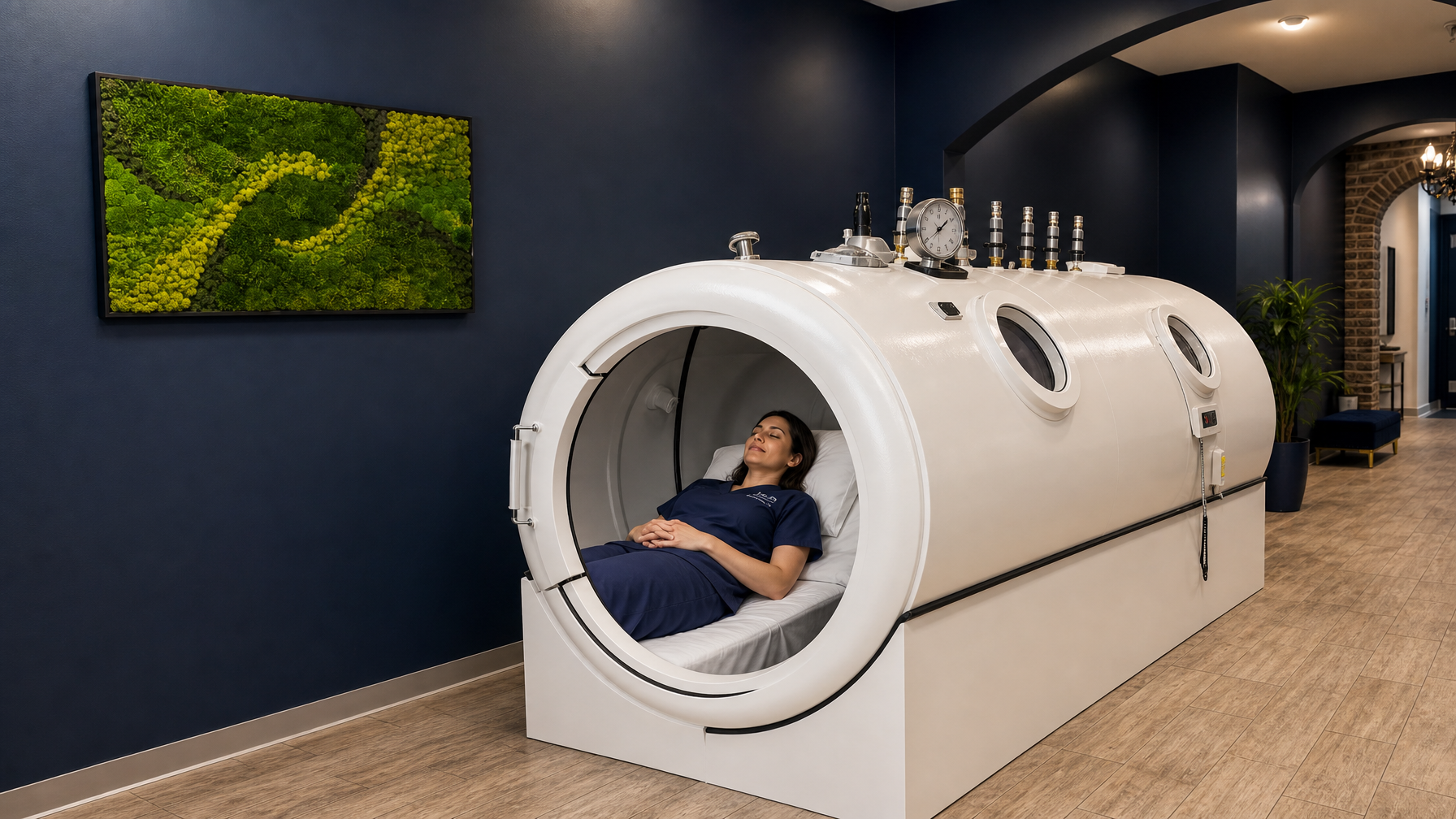
Each session at OxygenWell is 60–90 minutes. You arrive, change into comfortable clothing, and enter one of our medical-grade monoplace Fortius 420 chambers — the same class of equipment used in hospital hyperbaric units. The chamber pressurizes gradually over several minutes to 2.4 ATA. You breathe 100% medical-grade oxygen through a non-rebreather mask and can rest, watch a show, or simply relax.
Our Certified Hyperbaric Technicians (CHTs), most of whom are EMT-certified, monitor every session from outside the chamber. A physician assistant is on-site most weekday hours.
Post-BBL patients typically find sessions deeply relaxing. Many report visible reduction in swelling within the first 3 sessions.
Sessions are available at both our Sherman Oaks Galleria and Calabasas locations, 7 days a week with evening hours.
Frequently Asked Questions
Is HBOT safe right after a BBL?
Yes. HBOT is non-invasive — you breathe oxygen inside a pressurized chamber. There are no injections, incisions, or medications involved. The main contraindication to HBOT is untreated pneumothorax (collapsed lung), which is unrelated to BBL surgery. We review your surgical history and medical records before your first session to confirm safety.
Will HBOT interfere with my BBL results?
HBOT is designed to protect and improve your results, not interfere with them. By supporting fat graft survival and reducing destructive inflammation, it gives your transferred fat cells the best possible chance of forming a permanent blood supply. Multiple clinical studies support its use in fat transfer procedures.
Can I sit during my HBOT sessions after a BBL?
Yes. OxygenWell's monoplace chambers allow you to lie down comfortably. Post-BBL patients typically avoid direct pressure on the buttocks for several weeks per their surgeon's instructions — we accommodate this positioning in the chamber. Let us know your surgeon's restrictions when you book and we will prepare accordingly.
How soon will I see results from HBOT?
Most patients notice a visible reduction in swelling and bruising within the first 3–5 sessions. Improved skin tone, reduced discomfort, and faster return to normal activity are commonly reported in the first week of treatment.
Does insurance cover HBOT for BBL recovery?
BBL recovery is a cash-pay service at OxygenWell. Sessions are competitively priced, and we offer package pricing for multi-session protocols. In some cases where there is a compromised skin flap or tissue ischemia, insurance coverage may apply — our billing team will review your situation at no charge.
Do I need a referral from my plastic surgeon?
No referral is required to book at OxygenWell. However, we do recommend informing your surgeon that you are adding HBOT to your recovery protocol. Most plastic surgeons in the Los Angeles area are supportive and some actively recommend it.
Get Started at OxygenWell — Sherman Oaks or Calabasas
OxygenWell is the only physician-owned, insurance-approved HBOT center in the San Fernando Valley operating at the full 2.4 ATA with 100% medical-grade oxygen. We are open 7 days a week — including evenings — so your BBL recovery never has to wait for a weekday appointment.
Call (818) 661-0939 or email info@oxygenwell.com to book your first session or ask about our BBL recovery package.
Sherman Oaks: 15301 Ventura Blvd., Suite P-12 (Sherman Oaks Galleria) | Mon–Fri 9am–9pm, Sat–Sun 10am–6pm
Calabasas: 23500 Park Sorrento, Suite A2 | Mon–Fri 9am–8pm, Sat–Sun 10am–6pm
