


TLDR
A facelift lifts and repositions facial skin flaps — and the skin edges temporarily lose some of their blood supply. A published clinical study found that HBOT after a facelift reduces bruising by 35% at seven days post-op. At 2.4 ATA, HBOT saturates facial tissue with oxygen during the critical healing window, dramatically cutting visible swelling and bruising and helping patients return to their social lives sooner. Most facelift patients at OxygenWell start within 24–48 hours of surgery and complete 5–10 sessions over two weeks.
Table of Contents
- Why Facelift Recovery Has Unique Challenges
- What HBOT Does for Facelift Healing
- The Research: 35% Less Bruising
- HBOT and the Skin Flap Connection
- When to Start and How Many Sessions
- What a Session Looks Like at OxygenWell
- Frequently Asked Questions
- Book Your Facelift Recovery Protocol
Why Facelift Recovery Has Unique Challenges
A facelift (rhytidectomy) is one of the most effective cosmetic procedures for facial rejuvenation — but it is also one where the recovery is most visible. You cannot hide your face. Every day of bruising, swelling, or discoloration is a day you may feel self-conscious about being seen.
During a facelift, the surgeon creates skin flaps — areas of facial skin that are lifted, repositioned, and re-draped over the deeper structures. These flaps remain attached at their base, preserving primary blood supply, but the edges of the skin can experience temporary ischemia (reduced oxygen and blood flow). This edge ischemia is the primary reason facelift patients bruise so intensely and why swelling can linger for two to three weeks.
Smokers, patients with vascular disease, or those with thinner skin face a greater risk of skin flap complications. But even in healthy patients, the face is simply more demanding — the skin is thinner, the tissue is more delicate, and any visible compromise matters.
This is the precise window where HBOT delivers its most powerful results.
What HBOT Does for Facelift Healing
Breathing 100% medical-grade oxygen at 2.4 ATA dissolves oxygen directly into blood plasma at levels 10–15 times higher than normal. This plasma-dissolved oxygen reaches tissue even where blood cells cannot freely circulate — including the ischemic edges of repositioned skin flaps.
For facelift patients specifically, HBOT works through four mechanisms:
1. Oxygenation of the Skin Flap Edges
The leading edges of lifted skin flaps are farthest from their vascular base and most vulnerable to ischemia. HBOT floods this tissue with dissolved oxygen, keeping the cells metabolically active and preventing the cell death that causes tissue discoloration and compromised healing.
2. Dramatic Reduction in Bruising and Edema
Post-facelift bruising comes from vascular trauma — disrupted capillaries leak blood into surrounding tissue. HBOT constricts these damaged vessels (vasoconstriction) while simultaneously delivering high-dose oxygen, reducing the volume of blood pooling in the tissue. The result is visibly less bruising at an earlier stage of recovery.
3. Accelerated Collagen Synthesis for Incision Healing
Facelift incisions run along the hairline and around the ear. Their healing quality directly affects long-term scar appearance. HBOT stimulates fibroblast activity and collagen production, leading to stronger, finer, and less visible scars. Patients report that incisions close faster and look better at the two-week and six-week marks compared to those who did not use HBOT.
4. Antimicrobial Environment
Elevated tissue oxygen levels are toxic to the anaerobic bacteria responsible for most post-surgical skin infections. In a procedure where incisions trace along the hairline and scalp — areas with more bacterial load — this is a meaningful protective benefit.
The Research: 35% Less Bruising
The clinical evidence for HBOT in facelift recovery is unusually specific and compelling. Key studies include:
- Archives of Facial Plastic Surgery (2010) — A landmark study by Dr. Andrew Jacono, a renowned New York facial plastic surgeon, demonstrated that HBOT after facelift procedures reduces bruising by 35% at seven days post-operation. Dr. Jacono noted: "Hyperbaric Oxygen Therapy works to increase oxygen to facial tissue and stimulate the growth of new blood vessels, which in turn, contributes to a faster recovery." [Source: PRNewswire / Archives of Facial Plastic Surgery, 2010]
- PMC — Assessing the Efficacy of HBOT on Facelift Patients (2023) — A more recent peer-reviewed study directly assessed HBOT outcomes in facelift patients, confirming meaningful improvements in post-operative bruising, swelling, and recovery timeline. [Source: PMC, 2023]
- PMC — HBOT for the Compromised Graft or Flap (2017) — This foundational review established the mechanism by which HBOT protects ischemic skin flaps, providing the scientific basis for its use in facelift recovery. Compromised skin flaps are an FDA-approved HBOT indication — meaning insurance may cover treatment if flap compromise is documented. [Source: PMC, 2017]
For a procedure where the primary patient concern is "how soon can I be seen in public again," a 35% reduction in bruising at seven days is not a minor detail. It is the difference between two weeks of recovery and one.
HBOT and the Skin Flap Connection
Here is something most facelift patients don't know: compromised skin grafts and flaps is an FDA-approved indication for hyperbaric oxygen therapy. When a skin flap shows signs of ischemic compromise — poor color, sluggish capillary refill, tissue tension — HBOT is a recognized medical intervention, not an elective add-on.
This means that in cases where your surgeon documents skin flap concerns, your PPO insurance may cover HBOT sessions at OxygenWell. Our billing team handles pre-authorization at no charge and can coordinate directly with your surgeon's office.
For patients without documented complications, HBOT remains a powerful elective recovery enhancement — one that significantly improves comfort, appearance, and timeline during the first two critical weeks.
When to Start and How Many Sessions
Timing follows the same principle as all post-surgical HBOT: the earlier you start, the greater the benefit. For facelift recovery specifically:
- Ideal start: Within 24–48 hours of surgery — as soon as you can comfortably travel to the clinic
- Session frequency: Daily for the first week, then as needed in week two
- Standard protocol: 5–7 sessions (minimum), 8–10 sessions (recommended)
- Extended protocol: 10–15 sessions for patients who are smokers, have thinner skin, or want to optimize scar appearance through six weeks
Some patients choose to do 1–2 sessions before their facelift (pre-operative HBOT) to saturate facial tissues with oxygen and reduce baseline inflammation before the surgeon begins. Ask about this option when you call.
Sessions run 60–90 minutes. Many patients schedule their first post-operative session for the day after discharge and build it into their daily recovery routine alongside prescribed medications, lymphatic massage, and garment wear.
What a Session Looks Like at OxygenWell
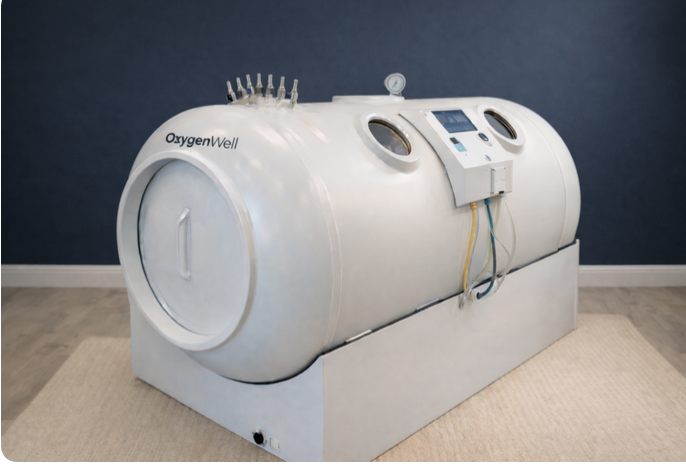
You arrive at OxygenWell Sherman Oaks or Calabasas, change into comfortable clothing, and lie or sit inside one of our Fortius 420 monoplace chambers. The chamber pressurizes to 2.4 ATA over several minutes. You breathe 100% medical-grade oxygen through a clear non-rebreather mask with a reservoir bag.
Sessions are quiet and deeply relaxing. Most facelift patients find the mild pressure sensation comfortable — comparable to driving down from altitude. You can rest, watch content on your device, or simply sleep.
Our Certified Hyperbaric Technicians (CHTs) monitor every session from outside the chamber. A physician assistant is on-site most weekday hours. Our Sherman Oaks location has a private VIP entrance if you prefer to avoid being seen in the main corridor during early recovery.
Both locations offer evening hours: Sherman Oaks until 9pm weekdays, Calabasas until 8pm weekdays, and both locations open weekends.
Frequently Asked Questions
Is it safe to do HBOT the day after a facelift?
Yes, for most patients. HBOT is non-invasive — there are no injections, no medications, and no contact with the surgical site. The only position requirement is lying or sitting comfortably inside the chamber. We review your surgical notes before your first session and coordinate with your surgeon if any specific positioning restrictions apply.
Will HBOT interfere with my medications after surgery?
Standard post-facelift medications (antibiotics, pain management, anti-inflammatories) are generally compatible with HBOT. The main caution involves certain chemotherapy drugs, which are not relevant to cosmetic surgery patients. Our clinical team reviews your full medication list before your first session.
My surgeon didn't mention HBOT. Can I still add it?
Yes. You do not need a referral to book at OxygenWell. We recommend informing your surgeon that you are adding HBOT, and the vast majority are supportive. If your surgeon wants to speak with our team about protocols, we are happy to facilitate that conversation.
Does HBOT help with facelift scars long-term?
Yes. HBOT stimulates collagen synthesis and fibroblast activity, which supports finer, less visible scar formation. Sessions in weeks two through six — even after visible bruising has resolved — continue to benefit the quality of incision healing and may reduce the appearance of post-operative scarring over time.
What about combination procedures — facelift plus neck lift or blepharoplasty?
Combination procedures increase the volume of tissue disruption and extend recovery complexity. HBOT is particularly beneficial when multiple facial areas are involved, as the cumulative trauma creates more widespread ischemia. We adjust session protocols based on your specific combination and surgeon notes.
Can HBOT help if I had a facelift weeks ago and am still swollen?
Yes. While early sessions deliver the most impact, HBOT can still reduce persistent swelling, support scar remodeling, and improve skin texture for patients who are several weeks post-op. Contact us and we will assess where you are in your recovery and design an appropriate protocol.
Book Your Facelift Recovery Protocol at OxygenWell
OxygenWell is the only physician-owned, insurance-approved hyperbaric center in the San Fernando Valley operating at the full 2.4 ATA with 100% medical-grade oxygen — the same standard used in hospital hyperbaric programs. Our Sherman Oaks location has a private VIP entrance for patients who prefer discretion during early recovery.
Call (818) 661-0939 or email info@oxygenwell.com to book or ask about our facelift recovery package.
Sherman Oaks: 15301 Ventura Blvd., Suite P-12 (Sherman Oaks Galleria) | Mon–Fri 9am–9pm, Sat–Sun 10am–6pm | Private VIP entrance available
Calabasas: 23500 Park Sorrento, Suite A2 | Mon–Fri 9am–8pm, Sat–Sun 10am–6pm | Free underground parking
