TLDR
Hyperbaric oxygen therapy (HBOT) centers in Los Angeles range from fully credentialed, physician-owned medical facilities to lightly regulated wellness studios operating equipment that falls far short of clinical standards. The gap between them matters — for your safety, your results, and your ability to use insurance. These 10 questions cut through the noise and give you a clear framework for evaluating any HBOT center before you commit.
Introduction
If you've been searching for hyperbaric oxygen therapy in Los Angeles, you already know the options are expanding rapidly. Clinics, wellness centers, and even some spas now advertise HBOT services. But hyperbaric oxygen therapy is a serious medical intervention — one where the quality of the equipment, the credentials of the team, and the rigor of medical oversight determine whether you get genuine therapeutic benefit or simply put yourself at risk.
California has some of the strictest healthcare regulations in the country. Hyperbaric facilities operating here are legally required to meet specific standards — but not all of them do. Patients who don't know what to look for are vulnerable to clinics that cut corners on safety, pressure ratings, oxygen delivery, or physician oversight.
This guide gives you the 10 most important questions to ask any HBOT center in Los Angeles before you begin treatment. Each question corresponds to a real clinical standard — one that separates facilities equipped to deliver medically meaningful outcomes from those that cannot.
Written by Dr. Beth Meneley, DAOM, L.Ac., Founder of OxygenWell — 25+ years in integrative medicine, 12+ years dedicated to hyperbaric medicine in Los Angeles, 50,000+ supervised HBOT sessions.
Table of Contents
Question 1: Are the Chambers FDA-Approved and Rated to Full 2.4 ATA — Not Just "Adjusted" to It?
Why This Matters
Pressure is the foundation of hyperbaric oxygen therapy. The therapeutic effects of HBOT — accelerated wound healing, stem cell mobilization, angiogenesis, telomere lengthening — are dose-dependent. Higher pressure, combined with the right session duration, drives meaningfully different physiological outcomes than low-pressure treatment.
Many centers advertise HBOT while operating chambers rated to only 1.3 to 1.5 ATA. Others claim to deliver 2.0 ATA but achieve this by "adjusting" a lower-rated chamber beyond its certified range — a practice that compromises both accuracy and safety. An FDA-approved chamber rated to 2.4 ATA is designed, tested, and cleared to operate at that pressure with full reliability.
At FDA-cleared pressures of 1.5 to 2.0 ATA, the body dissolves significantly more oxygen into plasma — enough to reach ischemic tissues that red blood cells cannot access. At 2.4 ATA, that effect is maximized. Undersea and Hyperbaric Medical Society (UHMS) protocols for FDA-approved indications are built around chambers that actually reach these pressures.
What to Ask
Ask the clinic: "What is the FDA clearance rating on your chambers — and is that the actual operational ceiling, or is it adjusted?" Request documentation if needed.
The OxygenWell Standard
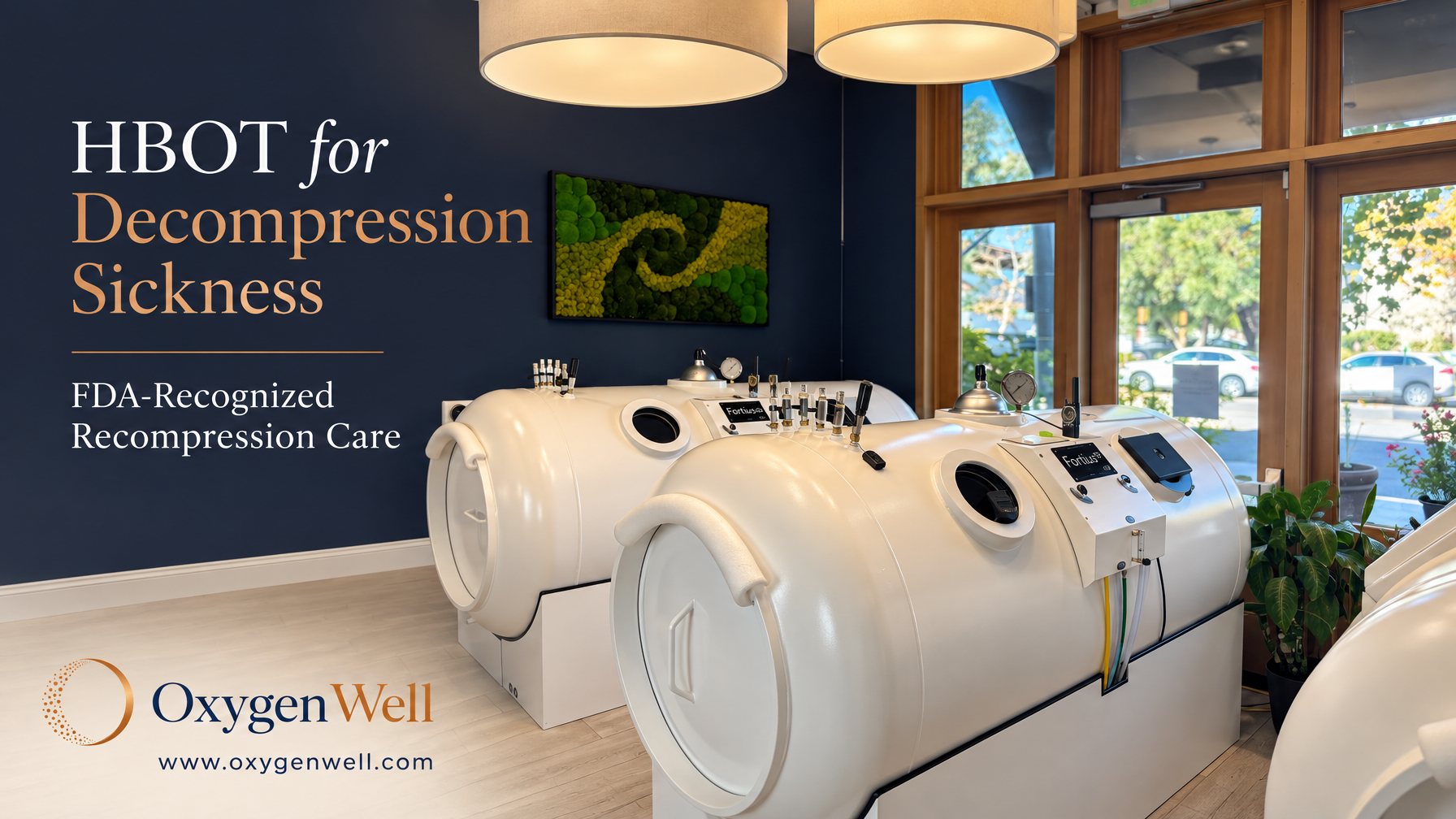
OxygenWell operates monoplace chambers that are FDA-cleared and fully rated to 2.4 ATA — the true therapeutic ceiling, not an adjusted estimate. Sessions for appropriate indications reach the pressure levels that peer-reviewed protocols specify. This is not the norm across Los Angeles HBOT centers.
Question 2: Are the Chambers Electrically Grounded?
Why This Matters
Hyperbaric chambers operate in an environment of 100% medical-grade oxygen at elevated pressure. That combination creates an extremely fire-accelerant atmosphere. In August 2025, the FDA issued a formal Letter to Health Care Providers reminding facilities of serious injuries and deaths associated with HBOT devices — and specifically cited fire prevention and electrical grounding as critical safety requirements. (FDA.gov, 2025)
Electrical grounding neutralizes static charge buildup inside and around the chamber. Without it, a static discharge in an oxygen-enriched environment can ignite. This is not a theoretical risk — it is documented in HBOT incident reports. The FDA's most recent guidance specifically calls on facilities to implement strict grounding protocols.
Wellness-oriented centers and non-medical HBOT studios frequently operate chambers that are not grounded to medical-grade electrical standards. This is one of the most overlooked safety factors patients never think to ask about.
What to Ask
Ask directly: "Are your chambers electrically grounded, and what is your fire prevention protocol?" A credentialed facility will answer this immediately and in full detail.
The OxygenWell Standard
Every chamber at OxygenWell is electrically grounded. Safety protocols are embedded into every session — from pre-treatment patient screening to post-session equipment checks. Medical-grade oxygen delivery combined with grounded chambers and rigorous fire prevention procedures is the standard the FDA expects and OxygenWell delivers.
Question 3: Do They Use a High-Flow Medical-Grade Oxygen System — Not a Standard 10-Liter Concentrator?
Why This Matters
Not all oxygen delivery systems are equivalent. A standard 10-liter oxygen concentrator is a consumer-grade device commonly found in home care settings. It is designed to deliver supplemental oxygen at atmospheric pressure — it is not engineered to supply 100% medical-grade oxygen at 2.0 to 2.4 ATA inside a hyperbaric chamber.
At therapeutic pressure levels, a concentrator cannot maintain the oxygen purity or flow rate that HBOT requires. The result: the patient inhales something closer to enriched air than true 100% medical oxygen. That gap in oxygen concentration directly reduces the therapeutic dose delivered per session.
Genuine medical-grade HBOT requires a high-flow oxygen system — typically a medical oxygen supply line or large compressed oxygen cylinders with regulators engineered for hyperbaric pressures. This is standard in hospital hyperbaric units and in credentialed standalone clinics.
What to Ask
Ask: "What oxygen delivery system do you use? Is it a concentrator or a medical-grade high-flow system?" If they cannot answer clearly, that is informative.
The OxygenWell Standard
OxygenWell uses a high-flow medical-grade oxygen system designed for hyperbaric pressures. Patients inhale 100% medical oxygen throughout every session. This is non-negotiable for the conditions OxygenWell treats — many of which require oxygen purity and delivery precision that a concentrator simply cannot achieve.
Question 4: Is the Facility Physician-Owned?
Why This Matters
California law requires that hyperbaric oxygen therapy facilities be physician-owned. This is a legal compliance requirement — not a marketing claim. Yet a significant number of HBOT centers operating in Los Angeles are owned by non-physicians: entrepreneurs, wellness companies, or investors who hire a physician consultant. The distinction is clinically and legally meaningful.
Physician ownership means the medical director has direct accountability for clinical protocols, patient safety standards, equipment decisions, and treatment outcomes. A non-physician owner can override clinical judgment on business grounds — and patients rarely know it's happening. A physician-owner cannot separate the clinical from the commercial: their license, their ethics, and their liability are all on the line.
California's Corporate Practice of Medicine doctrine exists precisely to protect patients from lay control of medical decisions. Non-physician-owned HBOT centers in California operate in legal gray territory — and if something goes wrong, the accountability structure is murky.
What to Ask
Ask: "Is this facility physician-owned? Who holds the ownership stake — a physician, a business entity, or an investor?" Request the name of the physician-owner, not just the medical director.
The OxygenWell Standard
OxygenWell was founded by and is physician-owned by Dr. Beth Meneley, DAOM, L.Ac., a doctor of acupuncture and oriental medicine with 25+ years in integrative medicine and 12+ years dedicated exclusively to hyperbaric medicine in Los Angeles. Dr. Meneley built OxygenWell from the ground up — the clinical protocols, the patient experience, the safety culture, and the medical standards all reflect her direct ownership and daily involvement. This is full compliance with California law and full alignment of medical accountability with patient care.
Question 5: Is the Facility Insurance-Approved for FDA-Indicated Conditions?
Why This Matters
Medicare and most PPO insurance plans cover hyperbaric oxygen therapy for the 18 FDA-approved indications — including diabetic foot wounds (Wagner Grade 3+), delayed radiation injuries, osteomyelitis, compromised skin grafts and flaps, carbon monoxide poisoning, and more. But coverage is not automatic. It requires that the facility meet the clinical, oversight, and safety standards that Medicare and insurers require for reimbursement.
Many HBOT centers in Los Angeles are not insurance-approved. They operate cash-pay only, often at lower pressure ratings or without the physician oversight structure that payers require. Patients with FDA-approved indications who use these centers pay out of pocket for treatment their insurance would otherwise cover — if they were at a compliant facility.
Insurance approval is a de facto quality signal. It means the facility has submitted to external review and meets the structural requirements — physician oversight, safety protocols, clinical documentation standards — that payers demand before authorizing reimbursement.
What to Ask
Ask: "Do you accept Medicare and PPO insurance for FDA-approved conditions? Do you handle pre-authorization, or does the patient manage that?" A credentialed facility handles pre-authorization proactively.
The OxygenWell Standard
OxygenWell accepts Medicare and PPO insurance for all FDA-approved HBOT indications. A dedicated billing team manages every pre-authorization — patients don't navigate that process alone. This access to insurance coverage is only possible because OxygenWell maintains the medical oversight, documentation, and compliance standards that payers require. For patients with covered conditions, this can mean the difference between treatment that is financially accessible and treatment that is not.
Question 6: Does the Medical Oversight Team Understand Both Hyperbaric Medicine AND Your Specific Disease State?
Why This Matters
Hyperbaric medicine is a specialty. Understanding how to deliver HBOT safely is a prerequisite — but it is not sufficient on its own. The conditions that bring patients to an HBOT center — diabetic wounds, radiation injuries, cancer support, traumatic brain injury, autoimmune disease, long COVID — each carry their own clinical complexity. A medical team that understands pressure physics but not oncology, or knows wound care but not neurology, cannot design a protocol that actually serves the patient's full clinical picture.
Protocol personalization matters. The pressure, session duration, frequency, and total session count appropriate for a patient preparing for IVF embryo transfer differ substantially from what a radiation-injured cancer patient needs — which differs again from a pediatric TBI case. Generic protocols may be safe; they are rarely optimal.
Additionally, some HBOT centers operate without awareness of contraindications. Certain chemotherapy agents — Bleomycin and Doxorubicin — have documented interactions with HBOT that require oncology clearance before any session. A medical team without oncology literacy may not screen for these.
What to Ask
Ask: "Will my protocol be customized to my specific diagnosis, and who designs it?" Ask specifically about their familiarity with your condition. Pay attention to how specifically they answer.
The OxygenWell Standard
Dr. Beth Meneley's background spans 25+ years in integrative and functional medicine — including hyperbaric medicine, oncology support, neurological recovery, hormonal optimization, and regenerative protocols. Every patient at OxygenWell receives a customized protocol based on their specific condition, disease stage, treatment history, and therapeutic goals. The 4-phase HBOT healing model — from immediate oxygenation through stem cell mobilization, angiogenesis and collagen synthesis, and cellular reprogramming for longevity — guides protocol design for every case.
Question 7: Is There Onsite AND Telemedicine Medical Director Oversight?
Why This Matters
Medical director oversight in HBOT is not simply about having a physician's name on the door. Meaningful oversight means the physician is clinically available — for initial evaluations, mid-course protocol adjustments, adverse event response, and ongoing clinical decision-making.
Some centers have a medical director who visits monthly, or who is reachable only by appointment. That structure creates gaps. HBOT sessions run daily for many patients. Clinical questions, symptom changes, and protocol refinements arise between scheduled physician visits. Telemedicine infrastructure allows a medical director to stay actively involved in real time — without requiring in-person visits for every clinical touchpoint.
Onsite capability handles acute situations. Telemedicine capability handles the continuity of clinical decision-making between sessions. Both matter.
What to Ask
Ask: "How is the medical director involved in ongoing patient care? Can patients reach a physician when questions arise between sessions — and by what means?"
The OxygenWell Standard
OxygenWell provides both onsite clinical evaluations and telemedicine support from the Medical Director. Patients have access to clinical guidance throughout their treatment course — not just at intake. This continuity of oversight is central to the personalized protocol model and is one of the structural requirements that supports OxygenWell's insurance-approval status.
Question 8: Is a PA or Medical Provider Onsite During Weekday Hours?
Why This Matters
Physician Assistants (PAs) and other advanced practice providers serve as an essential mid-tier clinical presence in a functioning hyperbaric facility. They handle clinical assessments, symptom evaluation, contraindication screening, patient education, and rapid response to any adverse reactions that arise during or between sessions.
In many HBOT centers, the only clinical staff present during sessions are technicians — regardless of what conditions are presenting. For patients with complex medical histories, active disease processes, or concurrent treatments such as chemotherapy or radiation, having a licensed medical provider physically onsite creates a meaningful safety margin.
Evening and weekend sessions, which many working patients depend on, often have no medical provider present at all in lower-credentialed centers. That gap is worth understanding before you schedule.
What to Ask
Ask: "Is a PA or medical provider onsite during the hours I would be treated? What is their clinical role during sessions?"
The OxygenWell Standard
Revital Ahl, PA-C is onsite at OxygenWell most weekday hours. Her presence provides patients with direct access to a licensed medical provider throughout their treatment — for clinical evaluation, protocol questions, symptom monitoring, and any concerns that arise mid-course. OxygenWell also offers extended hours including evenings and weekends, rare among HBOT centers in Los Angeles, giving working patients access to sessions outside standard business hours. Note that PA coverage is specific to most weekday hours; patients scheduling evenings or weekends should confirm staffing for their specific session time.
Question 9: Is There an On-Site Safety Director with Real Hyperbaric Experience?
Why This Matters
A Safety Director is the operational backbone of a credentialed hyperbaric facility. This individual is responsible for equipment maintenance, safety protocol enforcement, staff training, emergency preparedness, and regulatory compliance. In a high-pressure oxygen environment, this role is not ceremonial — it is the reason sessions run without incident.
The FDA's 2025 safety letter to health care providers emphasized that hyperbaric oxygen devices require disciplined adherence to manufacturer instructions and fire prevention protocols. That discipline comes from trained, experienced safety leadership — not from a rotating staff member who checks a compliance box.
Years of hyperbaric-specific experience matter here. The nuances of chamber maintenance, pressure system inspection, and oxygen safety are learned over time, in high-pressure environments, through the accumulation of thousands of sessions and continuous training. There is no shortcut to that expertise.
What to Ask
Ask: "Who is your Safety Director, and how many years of hyperbaric-specific experience do they have?" If the facility cannot name one, or cannot answer the experience question specifically, that is a critical gap.
The OxygenWell Standard
OxygenWell's Safety Director is Steven Kemp, with 12+ years of hyperbaric-specific experience. Steven has been in hyperbaric medicine long enough to understand not just the protocols but the edge cases — the equipment behavior, the patient variables, and the environmental factors that only reveal themselves over years of dedicated practice. His experience directly informs the safety culture at OxygenWell and provides the operational foundation that allows the clinical team to focus on patient care.
Question 10: Are the Technicians EMT-Certified?
Why This Matters
Certified Hyperbaric Technicians (CHTs) are the clinical staff who operate the chamber during patient sessions. They monitor pressure, oxygen delivery, patient status, and equipment performance throughout each session. Their competence and emergency training are the last line of clinical response if something unexpected occurs.
EMT certification adds a meaningful layer to technician capability. Emergency Medical Technicians train in rapid patient assessment, basic life support, emergency airway management, and clinical stabilization. In a hyperbaric environment — where a patient may present with an adverse pressure response, an anxiety episode, or an unexpected medical event — EMT-trained technicians can respond with clinical protocol rather than improvisation.
Many HBOT centers employ technicians with HBOT certification but without emergency medical training. Most of our staff at OxygenWell are not only Certified Hyperbaric Technicians (CHTs) but also EMT's.
What to Ask
Ask: "What certifications do your technicians hold? Are they EMT-certified in addition to their hyperbaric training?"
The OxygenWell Standard
Most technicians at OxygenWell are EMT-certified in addition to holding their Certified Hyperbaric Technician credentials. Donovan Moseley, for example, brings 15 years of healthcare experience to his role as a CHT at OxygenWell. This combination of emergency medical training and hyperbaric-specific expertise reflects what a highly trained care team actually means — not a credential on a wall, but clinical capability during every session.
Why the Standard of the Center Changes Everything
Hyperbaric oxygen therapy works by delivering a precisely calibrated dose of oxygen — at a specific pressure, for a specific duration, across a specific number of sessions — to trigger measurable physiological changes. The science is well-established. The outcomes are documented. But those outcomes only occur when the equipment, the team, and the oversight structure are all operating at the required standard.
A center that delivers 1.3 ATA with a concentrator, no physician ownership, and no EMT-trained staff is not delivering the same therapy as a center operating at up to 2.4 ATA with medical-grade oxygen, a physician-owner, and a 12-year Safety Director. They may share a name — "hyperbaric oxygen therapy" — but the clinical reality is categorically different.
The 10 questions above are not meant to be adversarial. They are the questions any patient has a right to ask and any credentialed facility should be able to answer immediately, clearly, and in full. The answers will tell you almost everything you need to know.
About OxygenWell: Hyperbaric Oxygen Therapy in Los Angeles
OxygenWell is a physician-owned HBOT and regenerative medicine center with locations in Sherman Oaks and Calabasas, CA, serving patients throughout greater Los Angeles. Founded and led by Dr. Beth Meneley, DAOM, L.Ac., OxygenWell has conducted 50,000+ supervised HBOT sessions across 12+ years of hyperbaric medicine practice.
OxygenWell holds insurance approval for all FDA-approved HBOT indications and accepts Medicare and most PPO insurance plans. Services include hyperbaric oxygen therapy, red light therapy (photobiomodulation), hydrogen inhalation therapy, hormone optimization, functional medicine, and longevity programs.
Extended hours — including evenings and weekends — make OxygenWell accessible to patients whose schedules don't accommodate standard clinic hours. This is among the rarest conveniences in the Los Angeles HBOT market.
— OxygenWell Brand Promise
We don't just meet the standard. We exceed it — for your safety, your results, and your peace of mind.
Schedule a Consultation
To learn whether HBOT is appropriate for your condition, or to find out if your treatment may be covered by insurance, call OxygenWell directly:
Sherman Oaks & Calabasas, CA
A member of our clinical team will answer your questions, review your history, and guide you through next steps — including insurance pre-authorization if applicable.
This article was written by Dr. Beth Meneley, DAOM, L.Ac., Founder and Medical Director of OxygenWell. Dr. Meneley holds 25+ years in integrative medicine and 12+ years dedicated to hyperbaric medicine in Los Angeles, overseeing 50,000+ supervised HBOT sessions. All clinical information reflects current UHMS guidelines and peer-reviewed literature.