TLDR
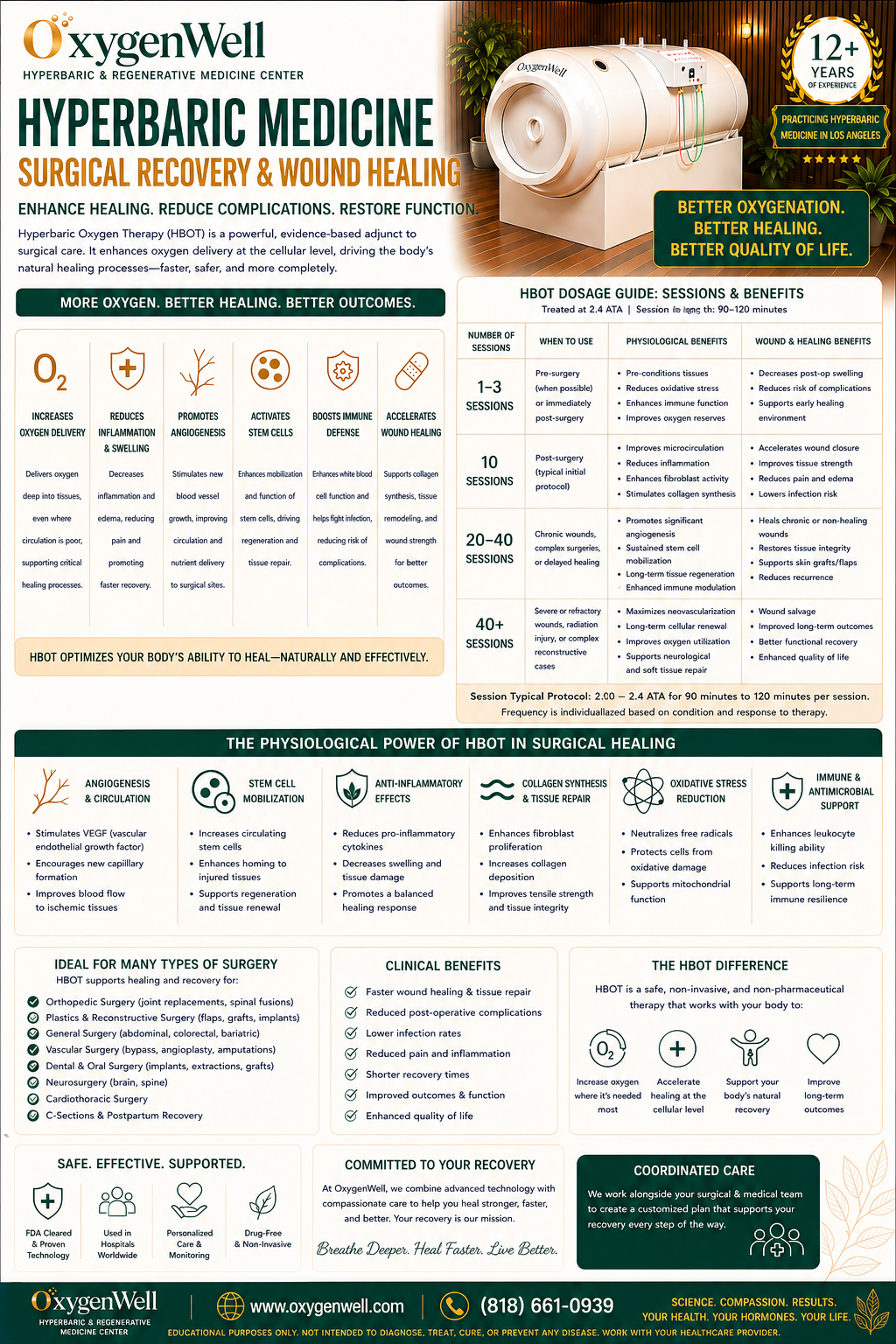
- Hyperbaric oxygen therapy after surgery delivers 100% medical-grade oxygen at 1.5–2.4 ATA, raising tissue oxygen levels up to 10–15x above normal to support healing.
- FDA-approved post-surgical indications include compromised skin grafts and flaps, delayed radiation injuries, refractory osteomyelitis, crush injuries, and diabetic wounds.
- Clinical research shows HBOT reduces surgical site infection relapse rates, shortens hospital stays, supports skin graft survival, and lowers post-operative inflammation markers.
- Cosmetic and elective surgery patients in Los Angeles increasingly use HBOT to reduce bruising and swelling and speed return to normal activity.
- OxygenWell's physician-led, insurance-accepted HBOT programs offer personalized post-surgical protocols at Sherman Oaks and Calabasas, CA.
What Does HBOT Do After Surgery?
Every surgical incision creates a micro-environment of oxygen deprivation. Swelling compresses capillaries, severed blood vessels restrict circulation, and healing tissue demands far more oxygen than the surrounding vasculature can deliver at normal atmospheric pressure. This hypoxic gap is where surgical complications begin — and where hyperbaric oxygen therapy intervenes.
During an HBOT session, a patient breathes 100% medical-grade oxygen inside a pressurized monoplace chamber operating at 1.5–2.4 ATA (atmospheres absolute). Under this pressure, oxygen dissolves directly into plasma, lymph, and cerebrospinal fluid — bypassing the red blood cell transport system entirely. The result: tissue oxygen levels rise to 10–15 times above baseline, reaching zones that compromised circulation cannot. (Johns Hopkins Medicine)
The biological cascade from that oxygen saturation drives every dimension of post-surgical recovery:
- Angiogenesis: HBOT triggers a sharp increase in Vascular Endothelial Growth Factor (VEGF), stimulating the budding of new capillaries directly into hypoxic wound tissue.
- Collagen synthesis: Oxygen is a required cofactor for hydroxylation of procollagen. Inadequate tissue pO2 is one of the primary reasons wounds stall. HBOT restores the substrate collagen-producing fibroblasts need.
- Stem cell mobilization: Research confirms that HBOT increases circulating CD34+ stem cells — the progenitor cells for new blood vessels and tissue — by up to 8x baseline after 20–40 sessions.
- Edema reduction: Vasoconstriction induced by hyperoxia paradoxically reduces swelling without compromising oxygen delivery, helping resolve the post-surgical inflammation that slows healing.
- Immune activation: Neutrophils require high local oxygen concentrations to perform their bactericidal function. HBOT restores this oxygen environment, significantly enhancing the immune system's ability to fight post-surgical infection.
The 4-Phase HBOT Healing Model
At OxygenWell, we use a structured 4-phase framework to explain what happens across a full post-surgical HBOT course:
PhaseSessionsKey Biological Events Phase 1Session 1Immediate tissue oxygenation 10–15x, ATP boost, edema and inflammation reduction Phase 2~10 sessionsVEGF increase, capillary budding, CD34+ stem cell mobilization (up to 8x baseline) Phase 320–30 sessionsMature angiogenesis, collagen synthesis, white matter repair, immune optimization Phase 440–60 sessionsTelomere lengthening, senescent cell reduction, cellular reprogramming, enhanced long-term tissue integrityFor most post-surgical patients, Phases 1–3 are the primary target — delivering meaningful wound closure, infection control, and tissue restoration within 20–40 sessions.
How Soon After Surgery Can You Start HBOT?
The short answer: as soon as medically cleared — often within 24–72 hours of surgery for elective and cosmetic procedures, and sometimes on the day of admission for urgent wound complications.
For elective cosmetic surgery (facelifts, tummy tucks, breast augmentation, 360 lipo), beginning HBOT within the first 24–72 hours post-operation captures the critical early inflammatory window. Reducing edema and initiating angiogenesis in this window has the greatest impact on visible bruising, swelling resolution, and incision healing speed.
For FDA-approved indications — compromised skin grafts and flaps, post-radiation wounds, and severe surgical infections — the urgency is higher. A failing graft begins to die within hours; HBOT initiated promptly can rescue tissue that would otherwise require re-operation.
Pre-surgical HBOT is also gaining traction. Patients who complete 2–5 sessions before a planned procedure arrive with better-oxygenated tissues, lower baseline inflammation, and a stronger immune state — reducing both intraoperative risk and post-operative healing time.
At OxygenWell, our physicians conduct a pre-treatment evaluation to determine the optimal timing and ATA protocol for each patient's specific surgery and health profile.
Which Surgeries Benefit Most from HBOT?
FDA-Approved Post-Surgical Indications (Insurance-Covered)
The FDA and Medicare explicitly recognize HBOT as medically necessary for a range of post-surgical complications:
- Compromised skin grafts and flaps — tissue transplanted during reconstructive surgery that shows signs of ischemia or failure
- Crush injuries and acute traumatic ischemia — tissue damaged by severe trauma or surgical compression
- Refractory osteomyelitis — chronic bone infection, often arising as a post-operative complication
- Necrotizing soft tissue infections — life-threatening infections that develop at surgical sites
- Delayed radiation injuries — osteoradionecrosis (ORN), soft tissue radionecrosis, radiation cystitis, and proctitis occurring after cancer surgery and radiation therapy
- Diabetic wounds (Wagner Grade 3+) — non-healing foot wounds, which frequently intersect with surgical intervention
High-Value Surgical Referral Categories
Beyond FDA-approved indications, HBOT delivers measurable clinical benefit in:
- Cardiac and thoracic surgery — sternal wound infections and mediastinitis after sternotomy are among the most studied HBOT applications
- Orthopedic surgery — total knee arthroplasty, spinal surgery, and complex fracture repair
- Oncologic surgery — any surgery in previously irradiated tissue, or in patients undergoing chemotherapy
- Head and neck surgery — post-radiation jaw and neck reconstruction requiring HBOT pre- and post-operatively (Marx Protocol)
- Reconstructive surgery — mastectomy reconstruction, burn grafting, and complex wound closure
Cosmetic and Elective Surgery
An expanding category of patients uses HBOT to optimize recovery from elective procedures including facelifts, rhinoplasty, blepharoplasty, breast augmentation, tummy tucks, mommy makeovers, 360 lipo and body contouring, and BBL. Insurance may also cover HBOT in cosmetic patients who develop compromised skin flaps or ischemia post-operatively.
Can HBOT Prevent or Treat Surgical Site Infections?
Surgical site infections (SSIs) affect up to one-third of surgical patients in low- and middle-income countries, and remain a significant burden in the United States. More than 50% of pathogens isolated from SSIs are now multidrug-resistant organisms — making alternative antimicrobial strategies critically important. (Medicina, 2023)
HBOT combats surgical infections through three distinct mechanisms:
- Direct bactericidal action: Under hyperoxic conditions, reactive oxygen species (ROS) form that are toxic to bacteria — particularly anaerobes that have no antioxidant defense.
- Immune potentiation: Neutrophils need a high local oxygen environment to phagocytose and destroy bacteria. HBOT restores that environment to infected wound tissue where circulation has been compromised.
- Antibiotic synergy: HBOT enhances the effectiveness of antibiotics including beta-lactams, quinolones, aminoglycosides, and vancomycin against resistant organisms including MRSA, reducing the total duration and dose of antibiotic therapy required.
The clinical data are compelling:
A prospective trial by Barili et al. (2007) studied 32 patients with post-sternotomy sternal wound infections after cardiac surgery. The HBOT group showed 0% infection relapse vs. 33.3% in the control group (p = 0.024), hospital stay of 52.6 days vs. 73.6 days in controls (p = 0.026), and IV antibiotic duration of 47.8 days vs. 67.6 days in controls (p = 0.036).
A separate retrospective study by Yu et al. (2011) of sternal osteomyelitis patients found that HBOT dramatically reduced ICU length of stay, duration of mechanical ventilation, and hospital mortality compared to patients who received conventional treatment alone.
In neuromuscular scoliosis surgery, a study by Inanmaz et al. (2014) found that HBOT prophylaxis cut the incidence of deep post-operative infections from 16.6% in the control group to just 5.5% in the HBOT group.
HBOT for Skin Grafts and Compromised Flaps
Skin graft and flap failure represents one of the most costly and distressing post-surgical complications in reconstructive medicine. Grafts and flaps transplanted to new anatomical locations depend entirely on the fragile process of revascularization during the first 48–96 hours. Any compromise — infection, ischemia, poor circulation, radiation damage — can cause necrosis that requires re-operation.
HBOT is FDA-approved and Medicare-covered for compromised grafts and flaps, and the evidence base is strong:
- Research by Durham et al. (Plast Reconstr Surg, 2017) found up to 2x higher flap survival rates with HBOT in compromised skin grafts and flaps.
- Multiple studies confirm that HBOT reduces ischemic tissue loss at wound edges, promotes faster take of split-thickness grafts, and reduces the probability of complete graft failure.
- A 2024 case report in ePlasty documented successful salvage of a compromised free flap with HBOT when surgical revision was not feasible. (PMC, 2024)
For mastectomy reconstruction patients, breast augmentation patients with compromised circulation, and any reconstructive surgery in previously irradiated tissue, HBOT is a powerful tool for protecting the surgical result.
HBOT After Cosmetic and Plastic Surgery in Los Angeles
Los Angeles has one of the highest concentrations of cosmetic surgery procedures in the world — and post-surgical HBOT is becoming a standard recovery tool for patients and plastic surgeons who want optimal aesthetic outcomes.
The core appeal is straightforward: faster resolution of bruising and swelling means patients look and feel better sooner. For time-sensitive Los Angeles professionals and patients who want minimal visible downtime, HBOT offers a clinically grounded approach to accelerating that timeline.
What post-cosmetic surgery patients at OxygenWell experience:
- Reduced bruising and swelling, typically resolving 30–50% faster
- Improved incision healing with reduced scar formation
- Enhanced collagen synthesis supporting skin texture and firmness
- Lower risk of infection at incision sites
- Faster return to work, social activity, and exercise
A 2023 case-control study published in PMC examined HBOT outcomes specifically in facelift patients, finding improved early recovery markers and reduced complication rates compared to patients who did not receive HBOT. (PMC, 2023)
OxygenWell is conveniently located across the street from Calabasas Medicine and serves patients throughout the greater Los Angeles area — including those referred by cosmetic surgeons in Sherman Oaks, Calabasas, Thousand Oaks, and the West Valley.
How Many HBOT Sessions Do You Need After Surgery?
Session count depends on the type and complexity of the surgery, the specific complication being addressed, and the patient's baseline health. General guidelines:
- Elective cosmetic surgery (low-risk): 3–10 sessions, beginning within 24–72 hours post-operation
- Reconstructive surgery / skin grafts / flaps: 10–30 sessions, initiated as soon as possible after signs of compromise appear
- Surgical site infections: 20–40 sessions in combination with antibiotic therapy and surgical debridement as needed
- Radiation injuries post-surgery (ORN, STNR, cystitis): 20–40+ sessions per the Marx Protocol at 2.0–2.4 ATA
- Diabetic surgical wounds (Wagner 3+): 30–60 sessions per FDA and Medicare protocols
- High-risk reconstructive surgery in irradiated tissue: Up to 20 sessions pre-operatively + 10–20 post-operatively (Marx Protocol)
The Marx Protocol for osteoradionecrosis — developed by Dr. Robert Marx — reduced ORN incidence following jaw surgery in irradiated patients from 29.9% to just 5.4%, cementing HBOT as a standard of care in head and neck oncologic surgery.
A 2025 randomized controlled trial in Scientific Reports found that HBOT after total knee arthroplasty significantly reduced muscle damage markers (CK, LDH, myoglobin) and inflammatory cytokines compared to normobaric oxygen, accelerating functional recovery. (Nature/Scientific Reports, 2025)
At OxygenWell, every patient receives a physician-designed protocol — not a one-size-fits-all session package. Dr. Beth Meneley and her clinical team review each patient's surgical history, co-morbidities, and wound status to design a course of treatment matched to their biology and goals.
Is HBOT Covered by Insurance for Post-Surgical Healing?
Yes — for FDA-approved indications, Medicare and most PPO insurance plans cover HBOT when performed at a qualifying physician-owned, properly credentialed facility.
Covered post-surgical indications include:
- Compromised skin grafts and flaps
- Delayed radiation injuries (ORN, STNR, radiation cystitis, proctitis)
- Refractory osteomyelitis
- Necrotizing soft tissue infections
- Diabetic wounds (Wagner Grade 3+)
- Acute traumatic ischemia / crush injuries
What makes OxygenWell insurance-eligible when many clinics are not:
California law requires hyperbaric facilities to be physician-owned — and OxygenWell meets that standard under the leadership of Dr. Beth Meneley. Many HBOT centers in the Los Angeles area are not physician-owned and therefore do not qualify for Medicare or PPO insurance reimbursement. OxygenWell's dedicated billing team handles all insurance pre-authorizations directly, removing that burden from patients and referring physicians. Call (818) 661-0939 to start the pre-authorization process.
Why OxygenWell Is Los Angeles's Choice for Post-Surgical HBOT
At OxygenWell, post-surgical patients receive something most hyperbaric centers cannot offer: physician-directed, individualized care built on 12+ years of hyperbaric medicine experience and 50,000+ supervised sessions.
- FDA-approved to 2.4 ATA — fully rated, not adjusted. Many Los Angeles centers operate at 1.3–1.5 ATA with oxygen concentrators, which does not meet FDA standards for on-label indications.
- Medical-grade oxygen, high-flow delivery — not a standard 10-liter concentrator.
- Grounded monoplace chambers — the gold standard for safety in HBOT.
- Physician-owned under California law — a legal and clinical compliance requirement that most area centers do not meet.
- Insurance-approved facility — OxygenWell accepts Medicare and PPO insurance for FDA-approved post-surgical indications.
- On-site Safety Director with 12+ years hyperbaric experience, PA on-site most weekday hours, and most technicians EMT-certified.
- Extended hours including evenings and weekends — designed for working patients in active surgical recovery.
- Whole-body integrative approach — Dr. Meneley's background in functional medicine means your recovery plan considers nutrition, inflammation, hormone status, and detoxification alongside HBOT.
Ready to accelerate your surgical recovery? Call OxygenWell at (818) 661-0939 or visit oxygenwell.com to schedule a consultation with Dr. Beth Meneley. We serve Sherman Oaks, Calabasas, and the greater Los Angeles area.
FAQ
Is hyperbaric oxygen therapy safe immediately after surgery?
For most patients, yes — HBOT is safe to begin within 24–72 hours of surgery once cleared by the operating physician. OxygenWell's physicians conduct a pre-treatment evaluation to confirm suitability. In urgent cases — particularly for compromised grafts or severe infections — HBOT can be initiated on the same day as the surgical complication is identified.
Does HBOT reduce bruising and swelling after surgery?
Yes. One of the most consistent patient-reported benefits of post-surgical HBOT is significant reduction in bruising and swelling — often resolving 30–50% faster than without treatment. The mechanism is HBOT-induced vasoconstriction, which reduces post-operative edema while simultaneously increasing oxygen delivery to the healing tissue.
Can HBOT save a failing skin graft or flap?
In many cases, yes. HBOT is FDA-approved and Medicare-covered specifically for compromised grafts and flaps. Research shows up to 2x higher flap survival rates when HBOT is initiated promptly after signs of graft compromise. The earlier HBOT begins after ischemia is identified, the greater the likelihood of tissue salvage.
How does HBOT compare to other post-surgical recovery tools?
HBOT is not a replacement for other recovery practices — it is additive. It works alongside proper wound care, physical therapy, nutrition, and prescribed medications. What distinguishes HBOT is its ability to address the root constraint in surgical healing: inadequate tissue oxygenation. No topical cream, compression garment, or anti-inflammatory drug resolves that constraint at the cellular level the way HBOT does.
Does insurance cover HBOT after plastic or cosmetic surgery?
Standard cosmetic surgery recovery (without complications) is generally not covered by insurance. However, if a post-cosmetic surgical complication occurs — such as a compromised skin flap, wound infection, or ischemia — Medicare and PPO insurance may cover HBOT under FDA-approved indications. OxygenWell's billing team handles pre-authorizations and can assess coverage eligibility during your initial consultation.
How is OxygenWell different from other HBOT centers in Los Angeles?
OxygenWell is physician-owned (required by California law), FDA-approved to 2.4 ATA, uses true medical-grade oxygen via a high-flow delivery system, operates grounded monoplace chambers, and accepts Medicare and PPO insurance for FDA-approved indications. Dr. Beth Meneley brings 25+ years in integrative medicine and 12+ years dedicated to hyperbaric medicine — along with 50,000+ supervised sessions — to every patient's care plan.
Where is OxygenWell located?
OxygenWell operates two locations in the greater Los Angeles area: Sherman Oaks and Calabasas (conveniently located across the street from Calabasas Medicine). Call (818) 661-0939 or visit oxygenwell.com to schedule.
OxygenWell is a physician-owned Hyperbaric Oxygen Therapy and Regenerative Medicine Center in Sherman Oaks and Calabasas, CA. Founded by Dr. Beth Meneley, DAOM, L.Ac. OxygenWell accepts Medicare and PPO insurance for FDA-approved conditions. Content on this page is for educational purposes and does not constitute medical advice. Please consult your physician before beginning any new treatment.