


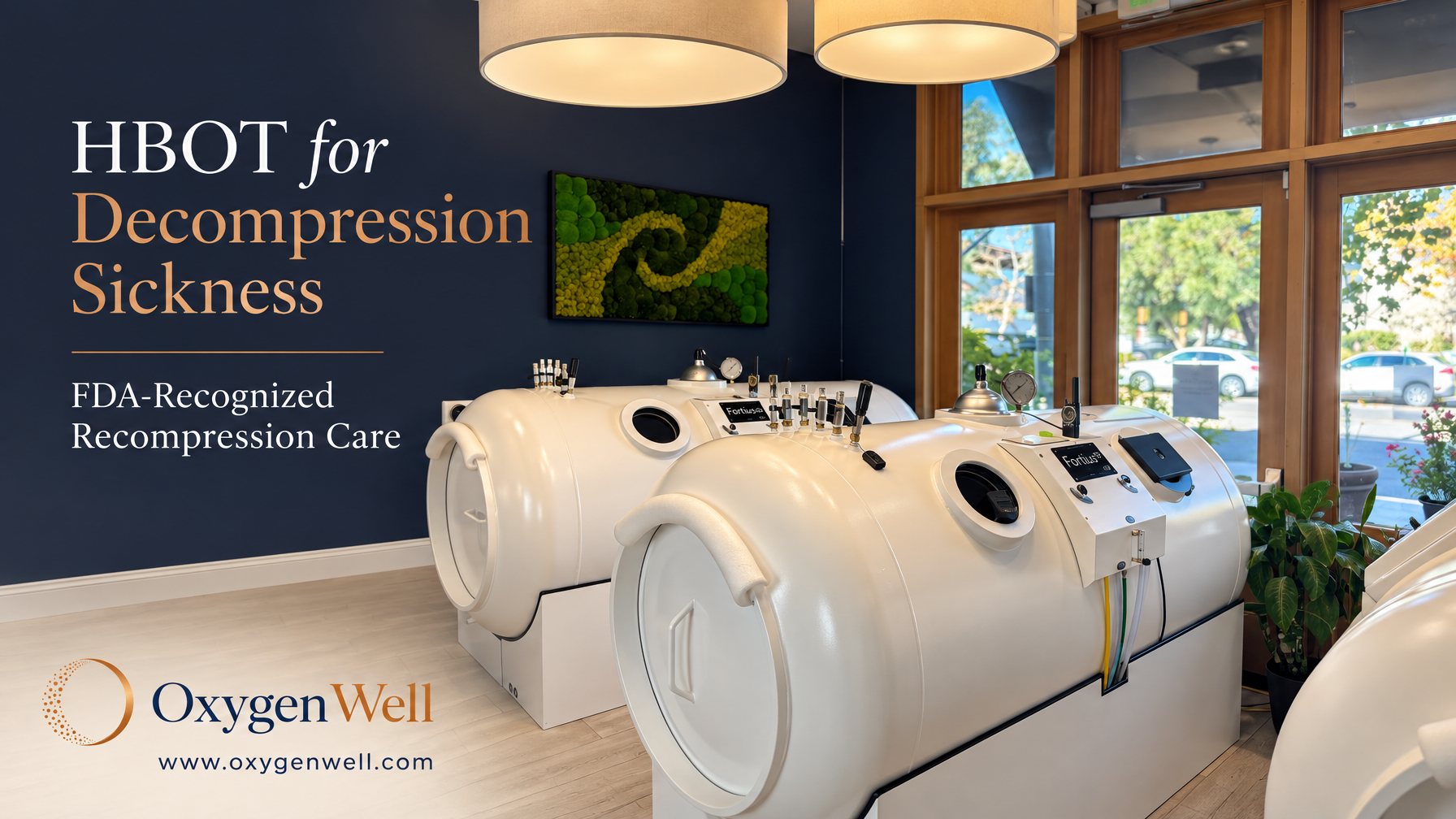
Decompression sickness (DCS), often called the bends, is one of the original reasons hyperbaric chambers exist. When ambient pressure falls too fast after a dive, a flight, or work in a pressurized environment, dissolved nitrogen can form bubbles in blood and tissue. Those bubbles obstruct flow, trigger inflammation, and can injure joints, skin, the inner ear, the spinal cord, or the brain. Recompression with hyperbaric oxygen is the definitive treatment.
The U.S. Food and Drug Administration lists decompression sickness among the conditions hyperbaric oxygen therapy is used to treat, as summarized by Cleveland Clinic and Mayo Clinic. The Undersea and Hyperbaric Medical Society (UHMS) treats HBO2 as a standard of care for decompression sickness.
This guide covers what DCS is, how it differs from arterial gas embolism, what to do first, and how medical-grade hyperbaric oxygen works. OxygenWell provides FDA-recognized hyperbaric care in Sherman Oaks and Calabasas. Dive injuries that look like an emergency belong in the ER first. Divers Alert Network (DAN) can help locate recompression.
TLDR
- DCS happens when nitrogen (or another inert gas) comes out of solution as bubbles after a rapid drop in pressure. Sport-diving incidence is about 3 cases per 10,000 dives (StatPearls / NCBI).
- Type I DCS involves joints, skin, or lymph. Type II involves the brain, spinal cord, or inner ear. Pulmonary DCS (“the chokes”) is rare and dangerous.
- Give 100% oxygen as soon as DCS is suspected, even if oxygen saturation looks normal. Then get to a hyperbaric chamber for recompression.
- HBOT shrinks bubbles, raises tissue oxygen, and is FDA-recognized for the bends. Mild spa-style chambers are not a substitute.
- Call DAN at +1-919-684-9111 for emergency dive-medicine guidance. For non-emergency questions about medical HBOT in Los Angeles, contact OxygenWell at (818) 661-0939.
Table of contents
- What is decompression sickness?
- Type I vs Type II DCS
- DCS vs arterial gas embolism
- First aid before the chamber
- How hyperbaric oxygen treats DCS
- Who is at risk
- Prevention and flying after diving
- HBOT at OxygenWell
What is decompression sickness?
According to StatPearls, DCS occurs when depressurized gas, usually nitrogen, leaves solution in tissues and forms bubbles that obstruct circulation. Typical settings: a too-fast ascent from scuba, leaving a caisson, flying in an unpressurized aircraft, or extravehicular activity in space.
At depth, nitrogen partial pressure rises and the gas dissolves into tissues. A slow, planned ascent lets that gas leave through the lungs. A rapid drop in ambient pressure lets bubbles form in blood and tissue. Those bubbles block vessels and drive inflammation. Joints, skin, lymph, inner ear, spinal cord, and brain can all be hit.
The CDC Yellow Book notes that decompression illness (DCI) is an umbrella term that includes both DCS and arterial gas embolism (AGE). Field teams often cannot tell them apart, and the first treatment is the same: high-concentration oxygen, then recompression (CDC Yellow Book, 2026).
DCS is a clinical diagnosis. Imaging is often nonspecific. Do not delay oxygen and recompression for a long workup. An untreated pneumothorax is an absolute contraindication to HBOT, so a chest x-ray is required if the diver is short of breath (StatPearls).
Type I vs Type II DCS
StatPearls groups presentations this way:
- Type I (the classic “bends”): skin, musculoskeletal, or lymphatic involvement. The shoulder is the most common joint. Cutis marmorata (mottled, netlike redness) can appear. Nodes may swell and hurt. This is the most common pattern.
- Type II: neurologic injury. Headache, visual or hearing change, nausea, tinnitus, poor coordination, weakness, bowel or bladder change, or altered mental status. Inner-ear DCS can occur with or without overt brain findings, especially with a patent foramen ovale or a helium-to-nitrogen gas switch.
- Pulmonary DCS (“the chokes”): cough, chest pain, or dyspnea. It can look like pulmonary embolism or asthma and can be fatal without immediate care.
About 75% of patients develop symptoms within the first hour after the precipitating event (StatPearls). Delayed neurologic, pulmonary, or skin symptoms can still respond to HBOT.
DCS vs arterial gas embolism
AGE is a lung-overpressure injury. Gas escapes from ruptured alveoli into pulmonary veins and then arteries, including those that supply the brain. CDC guidance: suspect AGE in any scuba diver who surfaces unconscious or loses consciousness within about 10 minutes of surfacing. Relapses happen. Evacuate to a hyperbaric facility even if the diver seems to recover (CDC Yellow Book).
AGE is a medical emergency. It is related to, but not the same as, DCS. Both sit under DCI. Both need oxygen and recompression. Read more on related gas-bubble emergencies in our guide to carbon monoxide poisoning and hyperbaric oxygen and the broader FDA-recognized HBOT indications.
First aid before the chamber
CDC and StatPearls agree on the sequence:
- Recognize unusual symptoms after a dive, especially neurologic ones.
- Give the highest practical oxygen fraction (100% when possible), even if saturation is normal. Surface oxygen can shrink nitrogen pockets and is first aid, not a replacement for the chamber.
- Support airway, breathing, and circulation. Start IV isotonic, glucose-free fluids when trained staff can do so. Oral fluids only if the diver is conscious and can protect the airway.
- Rule out pneumothorax before HBOT if the patient is dyspneic.
- Evacuate. Prefer a pressurized aircraft. If a helicopter is used, keep altitude at or below about 300 meters (1,000 feet) (StatPearls).
- Call DAN: +1-919-684-9111 (collect accepted) for 24-hour consultation, closest chamber, and transport help (CDC).
Trendelenburg and prolonged left-lateral positioning are no longer recommended; they raise cerebral-edema risk. Aspirin can mask pain. NSAIDs and steroids are no longer recommended as DCS treatment (StatPearls).
CDC notes that some mild, stable, remitting symptoms in remote settings might not require immediate recompression, but that call belongs to a dive-medicine physician after serial neurologic exams, not to the diver alone.
How hyperbaric oxygen treats DCS
Mayo Clinic describes HBOT as lifesaving for decompression sickness and for air bubbles in blood vessels. Inside the chamber, pressure typically rises to about 2 to 3 times normal air pressure while the patient breathes 100% oxygen. Effects that matter in DCS:
- Higher ambient pressure reduces bubble volume (Boyle’s law).
- A steep oxygen gradient helps nitrogen leave tissues and exit through the lungs.
- Oxygenated plasma can supply tissue even when bubbles impair red-cell flow.
UHMS advocates U.S. Navy oxygen treatment tables (or similar Royal Navy and Comex tables) as the clinical standard for recompression (PMC review of UHMS guidance). Mild “wellness” chambers that run near 1.3 ATA on concentrator oxygen do not deliver Navy-table recompression.
OxygenWell uses grounded monoplace chambers rated to 2.4 ATA with 100% medical-grade oxygen via non-rebreather mask. Certified hyperbaric technicians, most of them EMT-certified, run sessions, with a PA on site most weekday hours. That is the equipment class used for FDA-recognized indications, not a spa soak. For how medical HBOT differs from mild chambers, see What is hyperbaric oxygen therapy.
Session count depends on severity. Some DCS cases resolve after one or a few Navy-table treatments. Residual symptoms can need additional HBO2. Delayed treatment still helps many patients; do not assume the window has closed because hours have passed.
Who is at risk
DCS is uncommon in recreational diving because of better tables, computers, and training. StatPearls cites about 3 cases per 10,000 sport dives, and 1.5 to 10 per 10,000 among commercial divers. Male risk is reported as about 2.5 times female risk. Depth and bottom time still drive incidence.
Individual factors that raise risk: dehydration, patent foramen ovale, prior injury, cold water, higher body fat, recent alcohol, repetitive or deep profiles, strenuous work at depth, and flying too soon after diving (StatPearls; CDC).
Southern California divers often travel from Catalina, Channel Islands, or Baja and then drive inland. Symptoms that start on the boat, in the airport, or the next morning still deserve oxygen and a dive-medicine call, not a wait-and-see plan.
Prevention and flying after diving
Prevention is conservative diving: stay well within no-decompression limits, use safety stops, hydrate, and avoid forcing a dive when you feel unwell. CDC recommended pre-flight surface intervals after diving (these reduce, they do not eliminate, DCS risk):
- At least 12 hours after a single no-decompression dive
- At least 18 hours after multiple dives or multiple days
- 24 to 48 hours after a dive that required decompression stops
Commercial cabins sit near 6,000-8,000 feet equivalent. Asymptomatic divers should wait before altitude exposure above about 2,000 feet. Symptomatic divers need evaluation before any ascent (CDC Yellow Book).
HBOT at OxygenWell in Sherman Oaks and Calabasas
OxygenWell is a medical hyperbaric and regenerative center serving Los Angeles from Sherman Oaks and Calabasas. Chambers are rated to 2.4 ATA and deliver 100% medical-grade oxygen. We treat FDA-recognized indications, including decompression sickness, when a referring clinician and our team agree the patient is appropriate for outpatient or coordinated care after emergency stabilization.
If you or a dive buddy has joint pain, mottled skin, numbness, weakness, confusion, or breathing trouble after a dive, call 911 first if it looks like an emergency. Then involve DAN. For scheduled medical HBOT, insurance questions, or referring-clinician coordination in Los Angeles, call (818) 661-0939 or use oxygenwell.com/contact.
Related reading: What is HBOT, FDA-recognized indications, and carbon monoxide poisoning and the chamber.
This article is educational and is not a substitute for emergency care or DAN/UHMS dive-medicine advice. DCS and AGE can kill or disable. When in doubt, give oxygen and get specialist help.
