Table of Contents
- What Is a Compromised Skin Graft or Flap?
- Why Skin Grafts and Flaps Fail
- How HBOT Rescues Failing Grafts and Flaps
- The Science Behind HBOT and Tissue Survival
- What the Research Shows
- Treatment Protocol: What to Expect
- Insurance Coverage for HBOT After Skin Graft Surgery
- Frequently Asked Questions
- HBOT for Skin Grafts in Los Angeles
TLDR
Compromised skin grafts and flaps are among the most urgent post-surgical complications surgeons face. FDA-approved hyperbaric oxygen therapy (HBOT) delivers concentrated oxygen directly to oxygen-deprived tissue, stimulates new blood vessel formation, and dramatically improves graft and flap survival rates. Medicare and most PPO insurance plans cover HBOT for this indication. At OxygenWell in Sherman Oaks and Calabasas, patients receive physician-led HBOT in hospital-grade chambers at 2.0–2.4 ATA, with full insurance coordination from the first call.
What Is a Compromised Skin Graft or Flap?
Skin grafts and flaps are reconstructive surgical procedures used to repair tissue lost to trauma, burns, cancer resection, or chronic wounds.
A skin graft is harvested from a donor site on the patient's body and placed over a wound bed. Because the graft is fully separated from its original blood supply, it depends entirely on oxygen diffusing from the wound bed until new vessels grow in.
A skin flap retains some of its original vascular connections but is repositioned over a defect. Flaps used in breast reconstruction, head and neck cancer surgery, and diabetic foot repair all face the same challenge: fragile, newly established circulation that can fail under stress.
A graft or flap becomes "compromised" when circulation to the tissue is insufficient, swelling blocks oxygen delivery, infection overwhelms the healing tissue, or the wound bed has poor vascularity (such as in irradiated tissue). Signs of compromise include pallor, cyanosis, blistering, slow capillary refill, or frank necrosis at the graft margins. When these signs appear, the window to intervene is narrow.
Why Skin Grafts and Flaps Fail
The root cause of most graft and flap failure is tissue hypoxia — the wound simply does not receive enough oxygen to complete the healing process.
Poor wound bed vascularization. Wounds caused by radiation, peripheral vascular disease, or diabetes already have compromised circulation. A graft placed on this tissue starts at a disadvantage.
Venous congestion. When venous outflow is obstructed, tissue becomes engorged and edematous, oxygen delivery drops, and necrosis can set in within hours.
Infection. Bacteria consume oxygen rapidly. An infected graft site becomes profoundly hypoxic, creating conditions favorable for bacterial growth while starving the healing tissue.
Tension and mechanical stress. Grafts placed under tension lose their vascular contact with the wound bed, delaying the angiogenesis the graft needs to survive.
According to NIH StatPearls, studies report graft failure rates of 10–50% depending on wound type and patient comorbidities. For patients with diabetes, radiation history, or vascular disease, the risk is substantially higher.
How HBOT Rescues Failing Grafts and Flaps
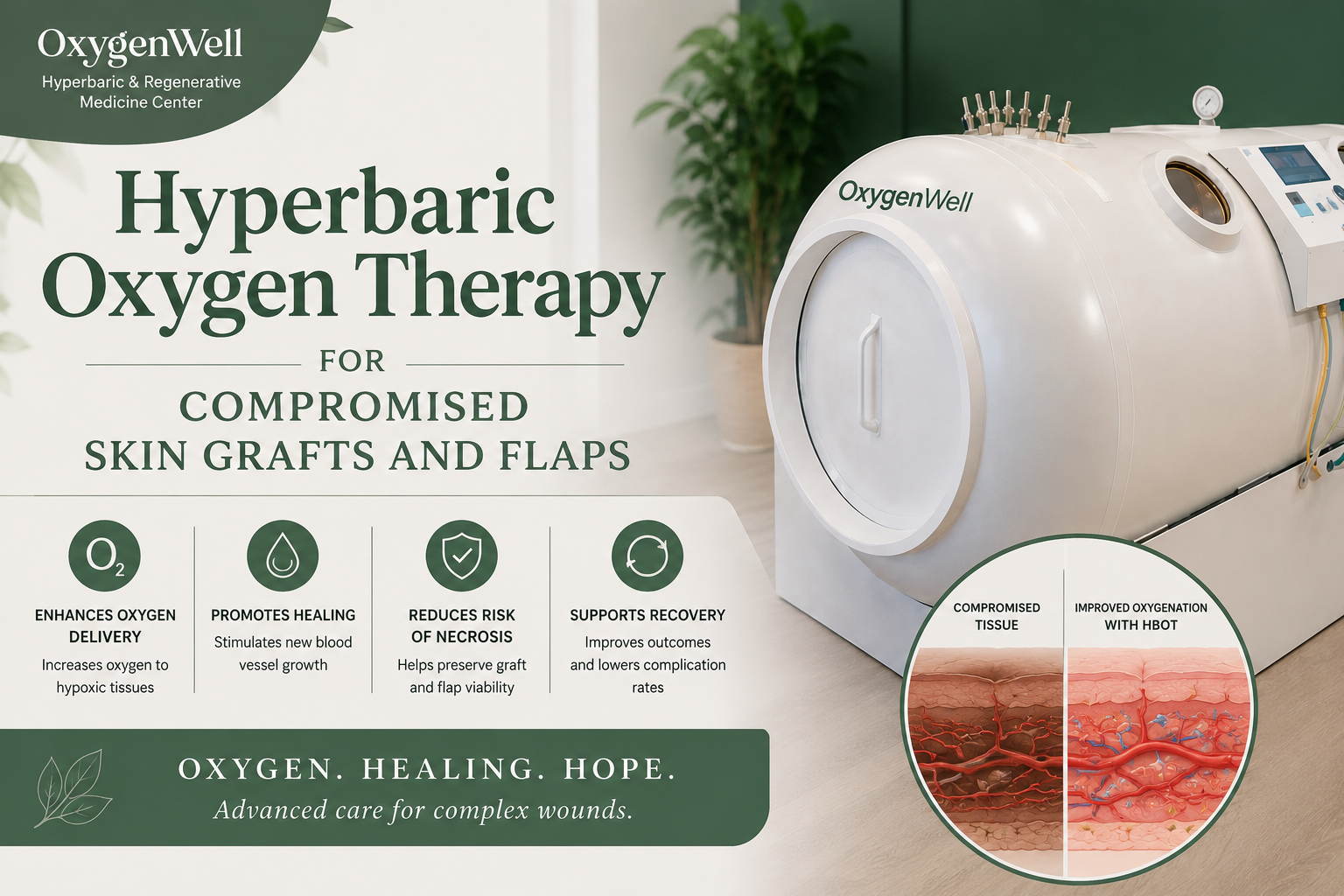
Hyperoxic plasma oxygen delivery. At 2.0–2.4 ATA breathing 100% oxygen, plasma oxygen content increases 10–15 times above normal. Oxygen dissolves directly into plasma and reaches tissues that red blood cells cannot penetrate due to swelling or vascular compromise.
Stimulation of angiogenesis. HBOT triggers VEGF release, driving new capillary formation directly into the graft bed. Each session followed by return to room air creates a hyperoxia-normoxia cycle that amplifies this angiogenic signal.
Reduction of reperfusion injury. HBOT's antioxidant effect blunts reperfusion injury and protects marginally viable tissue.
Anti-infective action. High oxygen levels are directly bacteriostatic and bactericidal against anaerobic organisms. HBOT also potentiates the oxidative burst of neutrophils, restoring the immune system's ability to fight infection in the wound.
Reduction of edema. Vasoconstriction under hyperoxic conditions reduces edema by approximately 20%, improving mechanical conditions for graft take without compromising oxygen delivery.
The Science Behind HBOT and Tissue Survival
The Undersea and Hyperbaric Medical Society (UHMS) officially recognizes compromised skin grafts and flaps as an approved indication for HBOT. A foundational review published in PMC (NIH) confirms that HBOT increases the probability of graft survival in hypoxic wound beds by restoring the oxygen gradient required for cellular proliferation and angiogenesis.
MechanismClinical Effect Plasma hyperoxiaDelivers O2 beyond vascular compromise VEGF upregulationNew capillary growth into graft bed Neutrophil potentiationEnhanced bacterial killing Edema reductionImproved mechanical graft contact Free radical scavengingReduced reperfusion injuryWhat the Research Shows
Graft salvage rates. Studies consistently show HBOT salvages 50–75% of grafts and flaps that would otherwise fail, reducing the need for surgical revision.
Breast reconstruction flaps. HBOT plays a specific role in salvaging TRAM flaps and DIEP flaps in breast reconstruction, particularly when the patient has received prior radiation to the chest wall.
Irradiated wound beds. HBOT is the only treatment proven to restore vascularity to hypoxic-hypovascular-hypocellular tissue created by radiation, making graft success possible in cases that would otherwise fail.
Diabetic and vascular patients. HBOT improves transcutaneous oxygen measurements (TCOM) in these patients, predicting and supporting successful graft take. Research by Durham et al. (Plast Reconstr Surg, 2017) found up to 2x higher flap survival rates with adjunctive HBOT.
Treatment Protocol: What to Expect
For compromised skin grafts and flaps, the standard HBOT protocol involves:
Session structure: 90–120 minutes breathing 100% oxygen at 2.0–2.4 ATA inside a monoplace chamber.
Frequency: Daily sessions, 5–7 days per week for the acute phase.
Number of sessions: Most protocols prescribe 20–40 sessions. The exact number depends on the wound's response, the underlying cause of compromise, and the patient's systemic health.
Timing: HBOT has the greatest impact when started within the first 24–48 hours of compromise. Early referral from the operating surgeon to a hyperbaric physician is critical.
At OxygenWell, physician referrals are processed rapidly. We coordinate directly with plastic surgeons, burn surgeons, and reconstructive teams in the Los Angeles area to ensure patients begin treatment within the therapeutic window.
Insurance Coverage for HBOT After Skin Graft Surgery
Compromised skin grafts and flaps are an FDA-approved indication for HBOT and are covered by:
- Medicare (Part B): Covers HBOT for compromised skin grafts and flaps with physician referral and documentation of clinical compromise.
- Private PPO insurance: Most PPO plans follow Medicare coverage guidelines for FDA-approved HBOT indications.
OxygenWell's clinical team manages insurance verification and authorization from the initial call, so referring physicians and patients can focus on healing rather than paperwork. Call (818) 661-0939.
Frequently Asked Questions
Can HBOT save a failing skin graft? Yes — HBOT can salvage grafts that show signs of compromise, including pallor, venous congestion, and marginal necrosis, when treatment starts early. Waiting until the graft is fully necrotic eliminates the therapeutic window.
How many HBOT sessions are needed for a skin graft? Most protocols prescribe 20–40 sessions. The exact number depends on the wound's response, the underlying cause of compromise, and the patient's systemic health.
Does HBOT hurt? No. The only sensation most patients notice is mild ear pressure during pressurization. The rest of the session is quiet and comfortable.
When should the surgeon refer for HBOT? Referral is most effective within 24–48 hours of recognized compromise. Signs indicating referral include cyanosis, pallor, blistering, decreased capillary refill, or significant venous congestion in the graft or flap.
Is HBOT safe after major surgery? Yes. HBOT is well tolerated by post-surgical patients. The treating hyperbaric physician reviews all medications and surgical history before treatment begins.
HBOT for Skin Grafts in Los Angeles
OxygenWell is a physician-owned hyperbaric and regenerative medicine clinic serving patients across the Los Angeles area from locations in Sherman Oaks and Calabasas. Led by Dr. Beth Meneley, DAOM, L.Ac., our team brings 25+ years in integrative medicine, 12+ dedicated years in hyperbaric medicine, and more than 50,000 supervised sessions to every patient encounter.
We work directly with plastic surgeons, reconstructive surgeons, burn teams, and wound care centers throughout Los Angeles to provide rapid, coordinated HBOT for compromised grafts and flaps. Our hospital-grade, FDA-cleared monoplace chambers operate at 2.0–2.4 ATA, and our clinical team manages insurance verification, pre-authorization, and physician communication from the first referral call.
For referring physicians: Call us directly at (818) 661-0939. We prioritize compromised graft and flap cases given the time-sensitive nature of intervention.
For patients: If your surgeon has told you your skin graft is not healing, or you are experiencing signs of graft or flap compromise, contact OxygenWell today to schedule a hyperbaric consultation. Insurance coverage verification is included in the initial consultation.