TLDR
Oxygen is the single most critical raw material for wound healing. When wounds fail to heal — due to diabetes, radiation, poor circulation, infection, or compromised blood supply — the common denominator is almost always tissue hypoxia: not enough oxygen reaching the wound. Hyperbaric Oxygen Therapy (HBOT) corrects this directly, delivering oxygen to ischemic tissue at concentrations 10–15x higher than normal breathing and triggering the biological processes required for wound closure. At OxygenWell in Sherman Oaks and Calabasas, HBOT for wound healing is covered by Medicare and most PPO insurance plans for qualifying conditions.
Table of Contents
- Why Oxygen Is the Foundation of Wound Healing
- Wound Types Treated with HBOT
- How HBOT Heals Wounds: Four Core Mechanisms
- Clinical Evidence
- Who Qualifies for Insurance Coverage?
- OxygenWell's Wound Care Protocol
- Frequently Asked Questions
Why Oxygen Is the Foundation of Wound Healing
Every step of the wound healing cascade requires oxygen:
- Hemostasis: Platelet function and clot formation require oxygen
- Inflammation: Neutrophils kill bacteria through oxygen-dependent oxidative burst
- Proliferation: Fibroblasts require oxygen to synthesize collagen — the structural protein that closes wounds
- Remodeling: Collagen cross-linking and scar maturation are oxygen-dependent
- Angiogenesis: New blood vessel growth — essential for sustained wound perfusion — is triggered by VEGF, which is upregulated by oxygen gradients
When tissue oxygen tension falls below 30 mmHg — as it does in diabetic wounds, radiation-damaged tissue, ischemic ulcers, and compromised grafts — this entire cascade stalls. Standard wound care can manage the wound surface; HBOT restores the oxygen environment that drives repair from within.
Wound Types Treated with HBOT
FDA-Approved (Insurance-Covered) Wound Conditions
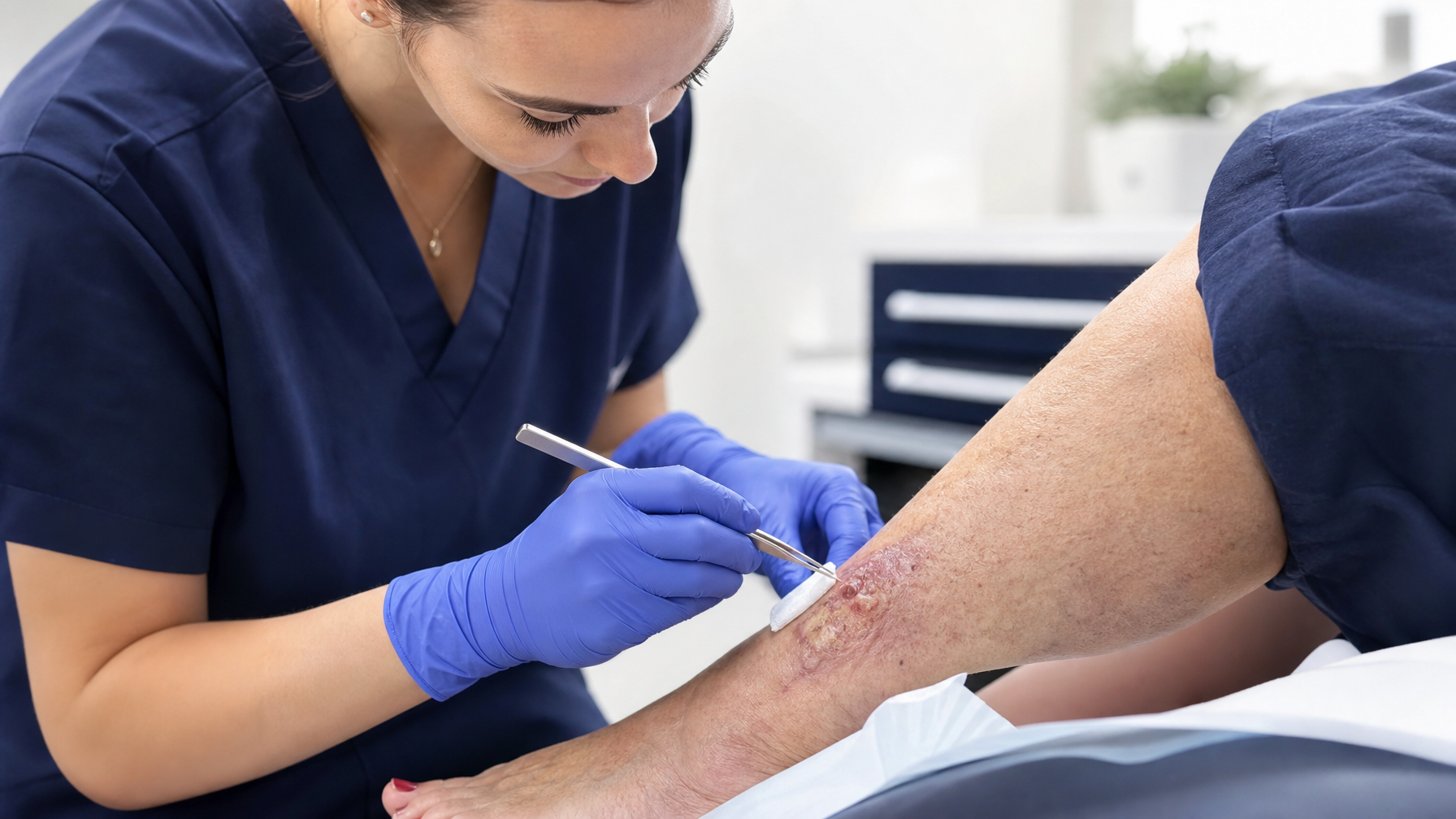
- Diabetic foot ulcers (Wagner Grade 3 and above) — one of the most common and evidence-rich HBOT indications
- Compromised skin grafts and flaps — HBOT significantly increases graft and flap survival rates
- Delayed radiation wounds — soft tissue radionecrosis, osteoradionecrosis, and radiation cystitis
- Chronic refractory osteomyelitis — bone infection with poor vascular supply
- Necrotizing soft tissue infections — gas gangrene and related severe infections
- Crush injuries and acute traumatic ischemia
- Thermal burns
Off-Label Wound Applications
- Surgical wound dehiscence
- Post-cosmetic surgery healing (facelift, breast reconstruction, liposuction, tummy tuck)
- Pressure ulcers (decubitus ulcers)
- Venous stasis ulcers
- Arterial insufficiency ulcers
- Non-healing surgical incisions in immunocompromised patients
How HBOT Heals Wounds: Four Core Mechanisms
1. Massive Elevation of Tissue Oxygen
Normal breathing at sea level delivers oxygen primarily via hemoglobin, raising tissue pO2 to approximately 40–60 mmHg in well-perfused tissue. At 2.4 ATA breathing 100% oxygen, plasma-dissolved oxygen alone raises tissue pO2 to 200–400 mmHg. This hyperoxygenated state reaches tissues that compromised blood vessels can no longer supply. [Hopf HW et al., Wound Repair Regen. 2004]
2. Angiogenesis — Rebuilding the Wound's Blood Supply
The repeated hyperoxia-normoxia cycles of an HBOT course create steep oxygen gradients that strongly stimulate VEGF production and endothelial progenitor cell recruitment. Over 20–40 sessions, new capillaries grow into the wound bed — establishing the blood supply that sustains healing after HBOT ends. [Thom SR, J Appl Physiol. 2011]
3. Collagen Synthesis and Wound Closure
Collagen production by fibroblasts requires oxygen as a direct enzymatic cofactor in the hydroxylation of proline and lysine. HBOT restores the tissue oxygen tension needed for full collagen synthesis, accelerating wound closure and producing stronger, more organized scar tissue. [Greif R et al., N Engl J Med. 2000]
4. Antimicrobial and Immune Enhancement
HBOT is directly bactericidal for anaerobic bacteria and bacteriostatic for staphylococcal species. Simultaneously, it restores neutrophil oxidative killing capacity — the immune mechanism most impaired by tissue hypoxia. This combined antimicrobial effect is particularly valuable in infected or colonized chronic wounds. [Knighton DR et al., Surgery. 1986]
Clinical Evidence
Diabetic Foot Ulcers: 4x Higher Healing Rates
A landmark study in Undersea and Hyperbaric Medicine reported healing rates up to 4x higher in Wagner Grade 3+ diabetic foot ulcer patients receiving HBOT compared to standard wound care alone. [Marx RE & Johnson RP, Undersea Hyperb Med. 2019]
Skin Grafts and Flaps: 2x Higher Survival
HBOT has been shown to increase flap and graft survival rates by up to 2x in compromised tissue, significantly reducing graft failure and the need for reoperation. [Tan CM et al., Plast Reconstr Surg. 2017]
Cochrane Review: Reduced Amputation Risk
A Cochrane systematic review confirmed that HBOT significantly reduces the risk of major amputation in diabetic foot ulcer patients and increases the likelihood of wound healing at one year. [Kranke P et al., Cochrane Database Syst Rev. 2015]
Who Qualifies for Insurance Coverage?
Medicare and most PPO plans cover HBOT for the following wound conditions:
- Diabetic foot ulcers (Wagner Grade 3+) — wound must have failed 30 days of standard care
- Compromised skin grafts and flaps
- Delayed radiation wounds (soft tissue radionecrosis, ORN)
- Chronic refractory osteomyelitis
- Necrotizing soft tissue infections
- Thermal burns
- Crush injuries / acute traumatic ischemia
A physician referral is required for all insurance-covered HBOT. OxygenWell handles all verification and pre-authorization. Verify your coverage at oxygenwell.com.
OxygenWell's Wound Care Protocol
OxygenWell is physician-owned, founded and led by Dr. Beth Meneley, DAOM, L.Ac., with over 50,000 HBOT sessions delivered across Sherman Oaks and Calabasas. Every wound care patient receives a personalized protocol based on wound type, severity, vascular status, and systemic factors.
- Pressure: 2.0–2.4 ATA (full therapeutic pressure for wound healing)
- Session length: 90 minutes
- Frequency: 5 days per week
- Total sessions: 20–40 sessions depending on wound type and response
- Oxygen: 100% medical-grade, high-flow delivery system
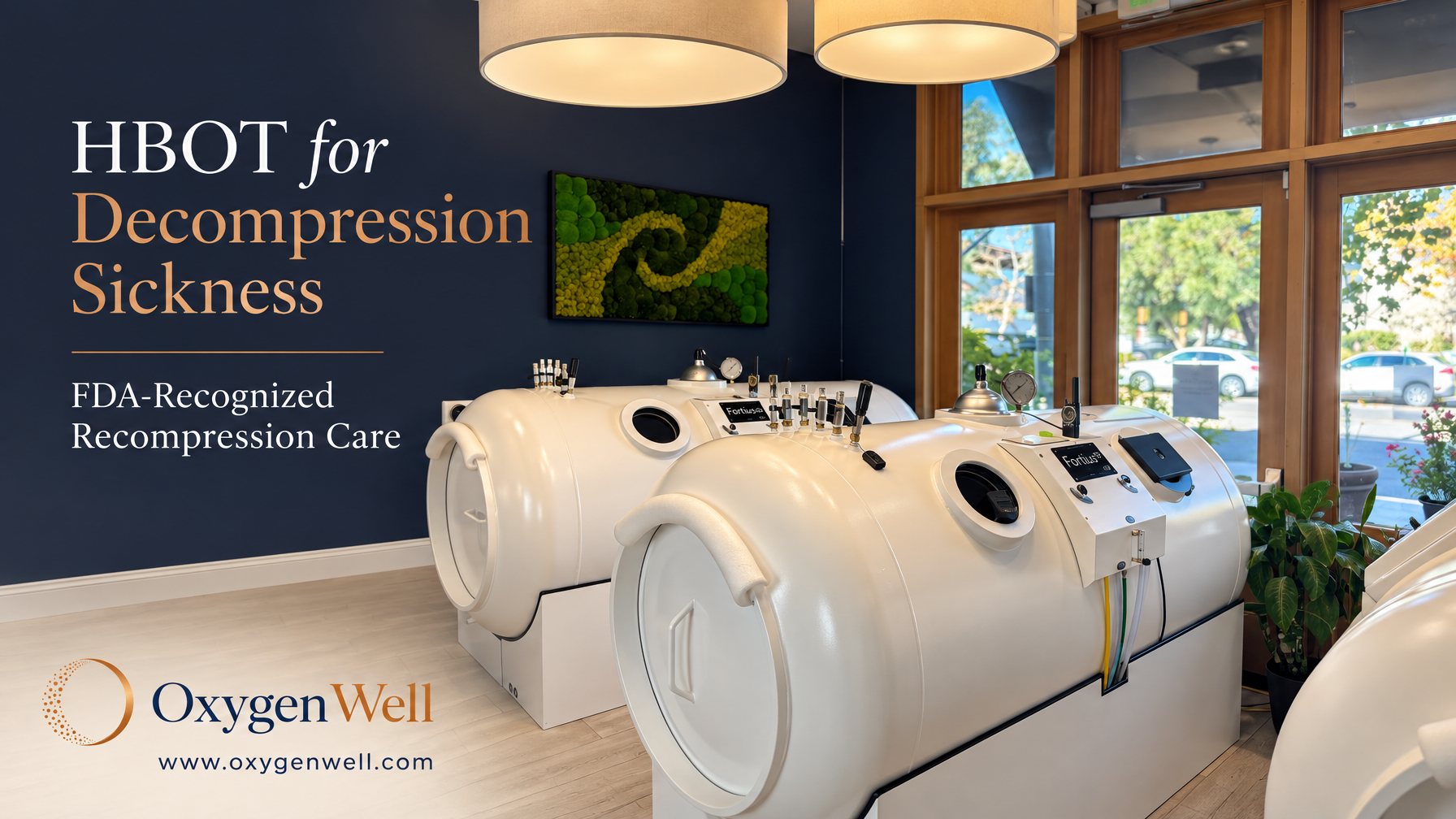
HBOT at OxygenWell is delivered in FDA-approved Fortius 420 monoplace chambers, supervised by Certified Hyperbaric Technicians (CHTs), most of whom are EMT-certified.
Frequently Asked Questions
How does HBOT compare to standard wound care?
Standard wound care manages the wound externally — debridement, dressings, offloading, infection management. HBOT addresses the underlying biology: restoring oxygen delivery, stimulating new blood vessel growth, and enabling collagen synthesis. They work best together. OxygenWell coordinates with your wound care team for an integrated approach.
How many sessions does it take to see results?
Many patients see measurable wound improvement within 10–15 sessions. Most complete wound care protocols involve 20–40 sessions total, delivered 5 days per week. Progress is monitored throughout and the protocol adjusted based on response.
Is HBOT covered by insurance for wound healing?
Yes — for qualifying conditions. Medicare and PPO plans cover HBOT for diabetic foot ulcers, compromised grafts, radiation wounds, osteomyelitis, and other FDA-approved indications. Call OxygenWell at (818) 661-0939 to verify your coverage before your first session.
Can HBOT help wounds from cosmetic surgery?
Yes. HBOT for post-cosmetic surgery wound healing is an off-label use but has strong clinical support for improving healing time, reducing swelling, and lowering infection risk. Insurance may cover it if there is a compromised flap or ischemic tissue. Self-pay options are available for elective post-surgical recovery.
Schedule a Consultation
- Sherman Oaks: 15301 Ventura Blvd., Suite P12, Sherman Oaks, CA 91403
- Calabasas: 23500 Park Sorrento, A2, Calabasas, CA 91302
- Phone: (818) 661-0939
- Website: oxygenwell.com
Written by Dr. Beth Meneley, DAOM, L.Ac. — Founder of OxygenWell. 25+ years in integrative and functional medicine. 12+ years dedicated to hyperbaric medicine in Los Angeles. Over 50,000 HBOT sessions administered under her clinical direction.