TLDR
Hyperbaric Oxygen Therapy (HBOT) is a medical treatment in which a patient breathes 100% pure oxygen inside a pressurized chamber. The increased pressure forces oxygen to dissolve directly into the blood plasma — reaching every tissue in the body at concentrations 10–15 times higher than normal breathing. This triggers powerful biological responses: new blood vessel formation, stem cell mobilization, reduced inflammation, accelerated wound healing, and neurological repair. HBOT is FDA-approved for 14 medical conditions and covered by Medicare and PPO insurance for qualifying patients. At OxygenWell in Sherman Oaks and Calabasas, we deliver medical-grade HBOT at up to 2.4 ATA under physician direction.
Table of Contents
- What Is Hyperbaric Oxygen Therapy?
- How Does HBOT Work?
- What Happens During a Session?
- What Conditions Does HBOT Treat?
- Medical-Grade HBOT vs. Mild Hyperbaric Therapy: The Difference
- How Many Sessions Do You Need?
- Is HBOT Covered by Insurance?
- Is HBOT Safe?
- HBOT at OxygenWell
- Frequently Asked Questions
What Is Hyperbaric Oxygen Therapy?
Hyperbaric Oxygen Therapy (HBOT) is the medical use of 100% pure oxygen delivered at greater than normal atmospheric pressure. The word "hyperbaric" means "greater than normal atmospheric pressure" — hyper (above) + baric (pressure).
During HBOT, a patient lies inside a sealed, pressurized chamber and breathes pure medical-grade oxygen for 60–90 minutes per session. The chamber is pressurized to 1.5–2.4 atmospheres absolute (ATA) — 1.5 to 2.4 times normal sea-level pressure. This combination of high-concentration oxygen and elevated pressure produces biological effects that neither supplemental oxygen alone nor pressure alone can achieve.
HBOT has been used in medicine for over 60 years, with FDA approval for 14 conditions and an extensive peer-reviewed evidence base spanning thousands of published studies.
How Does HBOT Work?
The mechanism of HBOT is grounded in two fundamental laws of physics and gas physiology:
Henry's Law: Oxygen Dissolves Directly into Plasma
Under normal conditions, oxygen is carried in the blood almost exclusively by hemoglobin — the protein inside red blood cells. Hemoglobin can only carry so much oxygen, and it can only deliver that oxygen to tissues with functional blood flow.
Henry's Law states that the amount of gas dissolved in a liquid is proportional to the partial pressure of that gas above the liquid. At 2.4 ATA breathing 100% oxygen, oxygen dissolves directly and abundantly into the blood plasma — the liquid portion of blood — independently of hemoglobin. This plasma-dissolved oxygen reaches tissues through simple diffusion, even when blood vessels are damaged, narrowed, or blocked.
The Result: Massive Tissue Oxygenation
A single HBOT session raises tissue oxygen tension from near-zero (in hypoxic wounds or injured tissue) to 200–400 mmHg — far beyond what hemoglobin can achieve. This floods oxygen-starved tissue with the raw material it needs to initiate repair. [Hopf HW et al., Wound Repair Regen. 2004]
Long-Term Biological Effects
Beyond acute oxygenation, repeated HBOT sessions produce lasting biological changes through the repeated cycling of high oxygen and normal pressure:
- Angiogenesis: New blood vessel formation via VEGF signaling — rebuilds circulation in damaged or ischemic tissue [Thom SR, J Appl Physiol. 2011]
- Stem cell mobilization: CD34+ bone marrow stem cells increase up to 8x baseline after 20 sessions, homing to sites of injury [Thom SR et al., Am J Physiol Heart Circ Physiol. 2006]
- Reduced inflammation: Down-regulation of NF-κB and pro-inflammatory cytokines (TNF-α, IL-1β, IL-6)
- Mitochondrial restoration: Improved ATP production and reduced oxidative stress at the cellular level
- Neuroplasticity: BDNF upregulation supporting brain repair and cognitive recovery
- Telomere lengthening: Observed after 40–60 sessions in longevity-focused protocols [Hachmo Y et al., Aging. 2020]
What Happens During a Session?
Here is what to expect at OxygenWell for a standard HBOT session:
- Preparation: You change into 100% cotton clothing (synthetic fabrics are not permitted inside the chamber). Blood glucose is checked if you are diabetic.
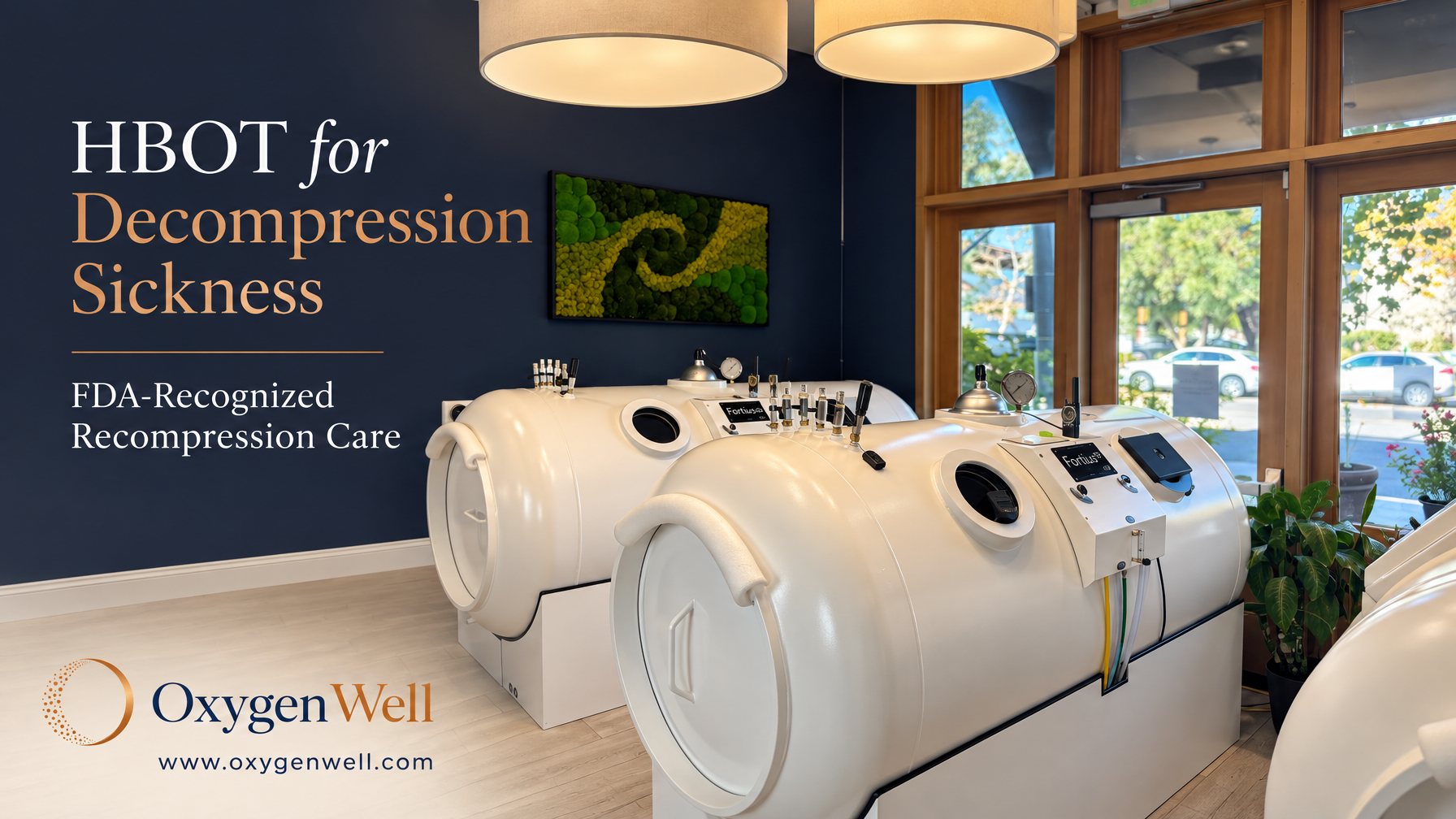
- Entering the chamber: You lie comfortably on the cushioned bed inside one of our Fortius 420 monoplace chambers. A non-rebreather oxygen mask is placed over your nose and mouth.
- Pressurization: The chamber pressurizes gradually over 10–15 minutes. You may feel a mild pressure sensation in your ears — similar to descending in an airplane — which resolves quickly by swallowing or yawning. Your technician coaches you through this.
- Treatment: You breathe normally and relax for 60–90 minutes at full pressure. Many patients sleep, listen to music, or simply rest. A Certified Hyperbaric Technician (CHT) monitors you throughout.
- Depressurization: The chamber slowly returns to normal pressure over approximately 10 minutes. Most patients feel refreshed and alert at the end of the session.
What Conditions Does HBOT Treat?
FDA-Approved, Insurance-Covered Conditions
- Diabetic foot ulcers (Wagner Grade 3+)
- Delayed radiation injuries (osteoradionecrosis, radiation cystitis, soft tissue radionecrosis)
- Chronic refractory osteomyelitis
- Compromised skin grafts and flaps
- Sudden sensorineural hearing loss
- Carbon monoxide poisoning
- Gas gangrene and necrotizing soft tissue infections
- Crush injuries and acute traumatic ischemia
- Central retinal artery occlusion
- Thermal burns
- Air or gas embolism
- Decompression sickness
- Exceptional blood loss (anemia)
- Intracranial abscess
Off-Label Conditions with Growing Evidence
- Long COVID (brain fog, fatigue, cognitive impairment)
- Traumatic brain injury (TBI) and concussion
- Stroke recovery
- Neurological conditions (MS, Parkinson's, autism spectrum)
- Lyme disease and post-infectious syndromes
- Chronic fatigue syndrome and fibromyalgia
- Post-surgical recovery (cosmetic and orthopedic)
- Anti-aging and longevity optimization
- Sports performance and recovery
- Fertility optimization
- Cancer support (adjunct to conventional treatment)
Medical-Grade HBOT vs. Mild Hyperbaric Therapy
Not all hyperbaric therapy is the same. There are critical differences between medical-grade HBOT and "mild hyperbaric therapy" offered in many wellness spas and health centers:
Feature | Medical-Grade HBOT (OxygenWell) | Mild Hyperbaric Therapy
Pressure | 2.0–2.4 ATA | 1.3–1.5 ATA
Oxygen source | 100% medical-grade oxygen | Ambient air (21% oxygen) or low-grade concentrators
Chamber type | FDA-approved hard-shell monoplace | Soft-sided portable tent
Physician ownership | Required in California | Often not physician-owned
Insurance coverage | Medicare and PPO accepted | Not eligible for insurance coverage
Angiogenesis trigger | Yes — at therapeutic pressure | Not demonstrated at 1.3–1.5 ATA
For FDA-approved medical conditions — wound healing, radiation injury, osteomyelitis — only medical-grade HBOT at therapeutic pressures produces the physiological effects required for genuine tissue repair.
How Many Sessions Do You Need?
Session requirements vary significantly by condition:
- FDA-approved wound conditions: 20–40 sessions, 5 days per week
- Neurological recovery (stroke, TBI): 40–60 sessions
- Long COVID: 40 sessions (RCT-validated protocol)
- Cosmetic surgery recovery: 3–10 sessions pre- and/or post-operatively
- Sports performance and wellness: 10–20 sessions in a course, with maintenance
- Longevity optimization: 40–60 sessions per protocol year
Is HBOT Covered by Insurance?
OxygenWell accepts Medicare and most PPO insurance plans for all FDA-approved HBOT indications. A physician referral is required. Our team handles insurance verification and pre-authorization before your first session — at no charge to you.
Off-label and wellness HBOT is self-pay. We offer package pricing and membership options. Call (818) 661-0939 or visit oxygenwell.com to verify your coverage.
Is HBOT Safe?
HBOT has an excellent safety profile when administered in a physician-led, properly equipped facility. The most common side effects are mild ear or sinus discomfort during pressurization (similar to flying), which resolves with proper equalization technique. Rare but serious side effects include oxygen toxicity seizures (extremely rare at therapeutic pressures with proper protocols) and barotrauma in patients with certain ear or lung conditions.
At OxygenWell, every patient undergoes a clinical evaluation before starting HBOT. Contraindications — including untreated pneumothorax and certain chemotherapy agents — are screened for before treatment begins. Sessions are supervised by CHTs, most of whom are EMT-certified.
HBOT at OxygenWell
OxygenWell is a physician-owned HBOT and regenerative medicine center in Sherman Oaks and Calabasas, CA. Founded and led by Dr. Beth Meneley, DAOM, L.Ac., OxygenWell has delivered over 50,000 HBOT sessions over 12+ years of dedicated hyperbaric practice in Los Angeles.
Our differentiators:
- FDA-approved Fortius 420 chambers rated to 2.4 ATA
- 100% medical-grade oxygen via high-flow delivery system
- Physician-owned — compliant with California law, insurance-eligible
- Medicare and PPO accepted for all qualifying conditions
- Grounded chambers for patient safety
- CHTs supervise every session, most EMT-certified
- Physician Assistant on-site most weekday hours
- Extended hours including evenings and weekends
- Integrated functional medicine, red light therapy, NAD+ IV, and hormone optimization
Frequently Asked Questions
Does HBOT hurt?
No. Most patients find HBOT relaxing. The only discomfort some patients experience is mild ear pressure during pressurization — easily managed with simple equalization techniques our staff teach you before your first session.
Can I bring my phone into the chamber?
No. Electronic devices are not permitted inside hyperbaric chambers due to fire risk in oxygen-enriched environments. Patients can listen to audio through a speaker system. Many patients use the session as an intentional rest period.
How is HBOT different from just breathing oxygen at home?
Home oxygen concentrators deliver 90–95% oxygen at normal atmospheric pressure. This raises hemoglobin saturation but does not force oxygen into plasma. HBOT at 2.4 ATA dissolves oxygen directly into plasma at therapeutic concentrations — fundamentally different physics, fundamentally different biological effects.
Can HBOT help with anti-aging?
A 2020 study in Aging found that 60 HBOT sessions produced significant telomere lengthening and a 37% reduction in senescent cells in healthy older adults — the first non-pharmacological intervention shown to produce these effects. [Hachmo Y et al., Aging. 2020]
Schedule a Complimentary Consultation
- Sherman Oaks: 15301 Ventura Blvd., Suite P12, Sherman Oaks, CA 91403
- Calabasas: 23500 Park Sorrento, A2, Calabasas, CA 91302
- Phone: (818) 661-0939
- Website: oxygenwell.com
Written by Dr. Beth Meneley, DAOM, L.Ac. — Founder of OxygenWell. 25+ years in integrative and functional medicine. 12+ years dedicated to hyperbaric medicine in Los Angeles. Over 50,000 HBOT sessions administered under her clinical direction.