TLDR
Crush injuries and acute traumatic ischemia cut off oxygen to muscle and nerve tissue — and the damage compounds fast. Hyperbaric oxygen therapy (HBOT) is an FDA-approved, Medicare-covered adjunct treatment that floods oxygen-starved tissue with up to 20 times the normal oxygen concentration, reduces dangerous post-reperfusion inflammation, and helps prevent limb-threatening complications. At OxygenWell in Los Angeles, we offer this therapy for patients referred by trauma surgeons, orthopedists, vascular surgeons, and emergency physicians who need a rapid, medically supervised hyperbaric response.
Table of Contents
- What Is a Crush Injury and Acute Traumatic Ischemia?
- What Is Compartment Syndrome — and Why Does It Matter?
- What Is Ischemia-Reperfusion Injury?
- How Does HBOT Treat Crush Injuries and Acute Traumatic Ischemia?
- Is HBOT FDA-Approved and Covered by Insurance for Crush Injuries?
- How Many HBOT Sessions Are Needed?
- When Should HBOT Start After a Crush Injury?
- HBOT for Crush Injuries at OxygenWell, Los Angeles
What Is a Crush Injury and Acute Traumatic Ischemia?
A crush injury occurs when a body part sustains prolonged compressive force — common in motor vehicle accidents, industrial incidents, falls, building collapses, earthquakes, or traumatic extrication. The compression does two things simultaneously: it causes direct mechanical tissue damage and it cuts off blood flow to muscles, nerves, and skin.
Acute traumatic ischemia is the resulting deprivation of oxygenated blood to tissue. The Undersea and Hyperbaric Medical Society (UHMS) recognizes acute traumatic peripheral ischemia — including crush injuries and suturing of severed limbs — as an approved indication for hyperbaric oxygen therapy. Medicare explicitly covers HBOT for this indication.
Crush injuries among civilians occur most often due to falls or extrication in building collapses, earthquakes, civil unrest, explosions, or high-speed motor vehicle accidents, according to StatPearls (2023). The injury population skews young — most patients are under 35 years old — which means the stakes for functional recovery are extraordinarily high.
The medical team's window for intervention is narrow. Muscle necrosis can begin as early as 2–3 hours after injury in up to 35% of crush injury patients, and nerve deficits with permanent loss may occur within as little as one hour. HBOT belongs in the early treatment plan, not as an afterthought.
What Is Compartment Syndrome — and Why Does It Matter?
One of the most dangerous sequelae of crush injuries is acute compartment syndrome (ACS). Human limbs are divided by fascial membranes into anatomic compartments. When a crush injury causes swelling and inflammation within one of these compartments, pressure builds rapidly. Once compartment pressure exceeds capillary perfusion pressure, blood flow to muscle and nerves stops.
The result is an "edema-hypoxia cycle": rising pressure halts venous return, fluid transudes into tissue, hypoxia activates adhesion molecules, neutrophils attach to vessel walls, reactive oxygen species (ROS) are released, and severe vasoconstriction follows. This is the foundation of reperfusion injury — and it can be more damaging than the original trauma.
The diagnostic standard is compartment pressure measurement via saline manometry. Any intercompartmental pressure above 30 mmHg in a symptomatic patient is confirmatory of ACS, as is a Delta Pressure (diastolic pressure minus compartment pressure) below 30. These findings warrant an urgent surgical consult for fasciotomy.
Clinically, impending ACS presents with the five "P's": pain out of proportion to injury, paresthesia, paresis, pallor, and pulse deficit.
ACS has three stages: suspected, impending, and established. Confirmed ACS requires immediate surgical fasciotomy. At the "impending" stage — where symptoms are progressing but manometrics are equivocal — HBOT can be introduced to interrupt the injury cascade and prevent progression to the established stage, according to the StatPearls clinical review (2023).
Timing of fasciotomy matters enormously. One landmark study found that fasciotomy performed within 12 hours of symptom onset resulted in normal function in 68% of patients — but when delayed beyond 12 hours, only 8% of patients recovered normal function. HBOT deployed early may reduce the risk of that delay becoming catastrophic.
What Is Ischemia-Reperfusion Injury?
Ischemia-reperfusion injury (IRI) is a paradox of modern trauma care: restoring blood flow to an ischemic limb — through fasciotomy, vascular repair, or thrombolysis — can trigger a secondary cascade of damage that is sometimes more severe than the original ischemia.
During ischemia, mitochondria shift to anaerobic metabolism and accumulate hypoxanthine. When blood flow and oxygen return, xanthine oxidase rapidly converts hypoxanthine, producing a flood of superoxide and hydrogen peroxide — reactive oxygen species that damage cell membranes, recruit neutrophils into tissue, and trigger inflammatory cytokine release including tumor necrosis factor-α (TNF-α). Endothelial cell-adhesion molecules activate, neutrophils invade local tissue, and the inflammatory cascade propagates far beyond the original injury zone.
HBOT is uniquely positioned to interrupt this cascade. Administered before or immediately after reperfusion, it can modulate inflammation, support microcirculatory function, maintain metabolic function in affected tissues, and decrease reactive oxygen species production and oxidative tissue damage, according to the StatPearls review on HBOT for ischemia-reperfusion injury (updated 2024).
Johns Hopkins Medicine confirms that HBOT prevents reperfusion injury by inhibiting the damaging inflammatory chain reaction and by delivering oxygen to tissue through plasma rather than red blood cells — bypassing obstructed or compromised microcirculation entirely.
How Does HBOT Treat Crush Injuries and Acute Traumatic Ischemia?
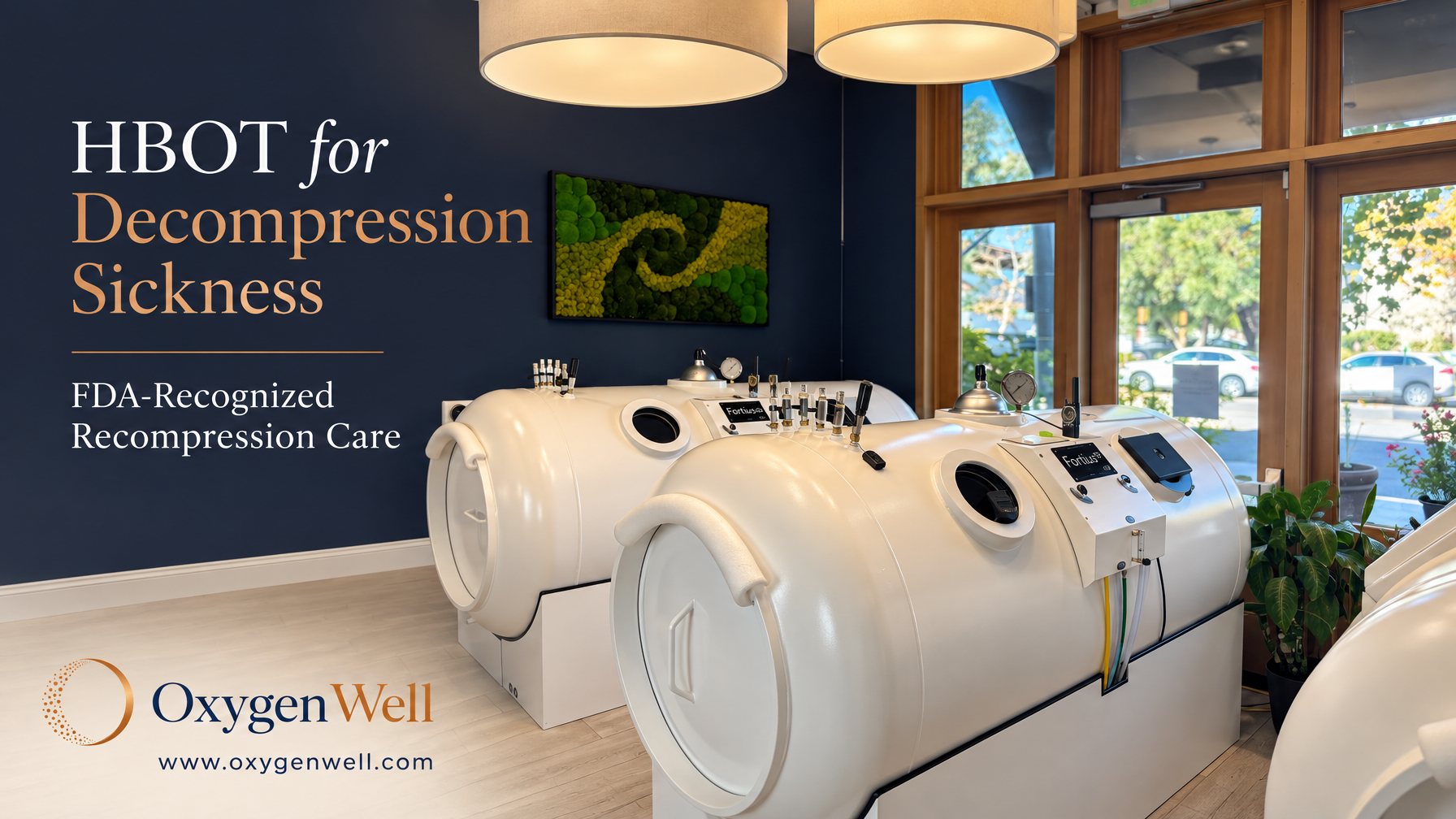
HBOT works by pressurizing the patient to greater than 1 atmosphere absolute (ATA) while breathing 100% medical-grade oxygen. At OxygenWell, we use Fortius 420 monoplace chambers rated to 2.4 ATA — full-pressure, true hyperbaric therapy, not the diluted "mild" hyperbaric sessions offered at many wellness centers.
At therapeutic pressure, oxygen dissolves directly into plasma at concentrations 20 times higher than breathing room air at sea level. This plasma-dissolved oxygen reaches ischemic tissue even when red blood cell transport is compromised — a critical distinction for crush injuries where microvascular flow is disrupted.
The StatPearls clinical review (2023) identifies three primary mechanisms by which HBOT benefits crush injury and compartment syndrome:
- Reduction of edema — The hyperoxic vasoconstriction HBOT induces decreases post-traumatic tissue swelling without compromising oxygen delivery (since plasma-dissolved oxygen compensates for reduced blood volume). Less edema means lower compartment pressure.
- Increased tissue oxygenation — Oxygen levels in tissue rise up to 20-fold, restoring ATP production, maintaining mitochondrial function, and preventing the aerobic-to-anaerobic metabolic shift that accelerates necrosis.
- Reduction of post-reperfusion injury — HBOT inhibits neutrophil-endothelial adhesion, blunts the ROS cascade, stimulates endogenous antioxidants, and modulates aquaporins (water-transport channels that become dysregulated during ischemia).
Beyond these three mechanisms, HBOT promotes angiogenesis via VEGF upregulation, stimulates collagen synthesis for wound repair, mobilizes CD34+ stem cells from bone marrow, and exerts direct and indirect antimicrobial effects — all of which matter in the subacute healing phase after fasciotomy and debridement.
A 2022 clinical case report in the Journal of Trauma and Injury confirmed: "Posttraumatic compartment syndrome responds well to HBOT, which reduces edema and contributes to angiogenesis, as well as promoting the cascade" of tissue healing. Multiple animal models have also demonstrated better outcomes when HBOT is used in crush injury and compartment syndrome, per a review in Undersea and Hyperbaric Medicine (Strauss, 2005).
Post-fasciotomy, HBOT has specific indications for:
- Ischemic muscle following decompression
- Unclear demarcation between viable and non-viable tissue
- Massive tissue swelling
- Prolonged ischemia exceeding 6 hours
- Vascular compromise of flap or graft coverage
- Residual neuropathy
If the crush injury leads to a compromised skin graft or flap — a common complication in severe extremity trauma — HBOT is also separately FDA-approved for that indication. Read more about HBOT for compromised skin grafts and flaps at OxygenWell.
Is HBOT FDA-Approved and Covered by Insurance for Crush Injuries?
Yes — on both counts. The FDA has cleared HBOT for acute traumatic peripheral ischemia, which includes crush injuries, compartment syndrome, and suturing of severed limbs. The UHMS lists this as a fully approved indication.
Medicare explicitly covers HBOT for acute traumatic peripheral ischemia and crush injuries. Most major commercial insurers — including UnitedHealthcare, Aetna, Cigna, and Blue Cross Blue Shield — also recognize HBOT as medically necessary for this indication.
OxygenWell is a fully credentialed, insurance-approved HBOT facility in Los Angeles. Our billing team manages the pre-authorization process, and our clinical team works directly with referring surgeons to document medical necessity and coordinate care. For trauma patients and their families, this means less administrative burden at one of the most stressful times of their lives.
This matters particularly for physicians who want to refer patients: OxygenWell meets the FDA, medical oversight, and safety standards required for insurance coverage. Centers operating at 1.3 ATA or using oxygen concentrators rather than a high-flow medical-grade oxygen delivery system may not qualify for insurance reimbursement for this indication.
How Many HBOT Sessions Are Needed?
The standard HBOT protocol for impending compartment syndrome following crush injury, per the StatPearls clinical review (2023), is:
- Pressure: 2.0–2.5 ATA (OxygenWell's chambers are rated to 2.4 ATA)
- Duration: 90–120 minutes per session
- Schedule: Two sessions on day 1, then one session on day 2 — three initial treatments in the acute phase
For subacute management — including post-fasciotomy healing, wound closure, compromised flap survival, and residual neuropathy — treatment schedules extend based on clinical response, often continuing daily or twice-daily sessions until tissue viability is established and healing trajectories stabilize.
At OxygenWell, our protocols are individualized by Dr. Beth Meneley and our medical team based on injury severity, surgical status, compartment pressure trends, and the patient's overall physiology. We work in close coordination with the treating surgeon to align HBOT timing with operative and post-operative milestones.
When Should HBOT Start After a Crush Injury?
Early initiation is critical. The pathophysiology of crush injury and compartment syndrome moves fast: muscle necrosis can begin within 2–3 hours of compression in a significant proportion of patients. The window in which HBOT can prevent irreversible tissue damage — rather than simply treating damage after the fact — is measured in hours, not days.
For ischemia-reperfusion injury, the StatPearls IRI review (2024) notes that when HBOT is initiated early enough post-injury, it may mitigate the reperfusion response entirely — not just reduce its sequelae.
HBOT for crush injuries fits into the treatment plan at three key moments:
- Impending ACS (pre-fasciotomy) — When compartment pressures are elevated but not yet in the "established" range requiring urgent surgery, HBOT can be initiated to prevent progression. It should never delay a clearly indicated fasciotomy.
- Peri-operative — HBOT can be administered around surgical decompression to reduce the reperfusion injury cascade triggered by restoring blood flow.
- Post-fasciotomy and subacute healing — To support wound closure, graft viability, nerve recovery, and functional tissue salvage in the days and weeks after surgery.
Referring physicians can contact OxygenWell directly to discuss urgent cases. Our team is experienced in coordinating rapid-access HBOT for time-sensitive indications — including central retinal artery occlusion and other acute vascular emergencies.
HBOT for Crush Injuries at OxygenWell, Los Angeles
OxygenWell is Los Angeles's premier hyperbaric and regenerative medicine center, with locations in Sherman Oaks and Calabasas. We offer full-pressure HBOT at up to 2.4 ATA — the therapeutic range required for FDA-approved acute traumatic ischemia treatment — in Fortius 420 monoplace chambers with 100% medical-grade oxygen delivery.
Founded and guided by Dr. Beth Meneley, DAOM, L.Ac. — with 25+ years in integrative medicine and 12+ years dedicated to hyperbaric medicine in Los Angeles — OxygenWell brings a functional medicine and root-cause approach to every patient protocol. Dr. Meneley and our team have supervised more than 50,000 HBOT sessions. Our Certified Hyperbaric Technicians (CHTs) are among the most experienced in Southern California, with most holding EMT certification.
OxygenWell is an insurance-approved facility. For crush injury and acute traumatic ischemia cases, our team handles pre-authorization and works directly with referring surgeons to document medical necessity and coordinate care timing.
For trauma patients, every hour matters. OxygenWell offers extended hours including evenings and weekends — a rare advantage in HBOT care that allows us to support acute and subacute cases without forcing patients into a Monday-through-Friday window.
To refer a patient or discuss a case with our clinical team, call (818) 661-0939 or visit www.oxygenwell.com. You can also review our physician referral information here.
About the Author
Dr. Beth Meneley, DAOM, L.Ac. is the Wellness Director and Co-Owner of OxygenWell Hyperbaric & Regenerative Medicine Center in Sherman Oaks and Calabasas, CA. With 25+ years in integrative medicine and 12+ years dedicated to hyperbaric medicine in Los Angeles, Dr. Meneley has supervised more than 50,000 HBOT sessions. She is a Doctor of Acupuncture and Oriental Medicine with a clinical background spanning functional medicine, oncology, fertility, immunology, and environmental medicine.
References
- Herron T, Haftel A, Torp KD, Cooper JS. Hyperbaric Treatment of Crush Injury and Compartment Syndrome. StatPearls. 2023.
- Robins M, Falkson SR, Goldfarb J, Wyatt HA. Hyperbaric Treatment of Ischemia Reperfusion Injury. StatPearls. 2024.
- Strauss MB. The effect of hyperbaric oxygen in crush injuries and skeletal muscle-compartment syndromes. Undersea Hyperb Med. 2012;39(4):847–55. PubMed.
- Kim JH, et al. Hyperbaric oxygen therapy for the treatment of a crush injury. J Trauma Inj. 2022. Link.
- Medicare.gov. Hyperbaric Oxygen Therapy Coverage.
- Johns Hopkins Medicine. Hyperbaric Oxygen Therapy.
- Mathieu D, Marroni A, Kot J. Tenth European Consensus Conference on Hyperbaric Medicine. Diving Hyperb Med. 2017;47(1):24–32. PMC.